








By CalNews360 Staff
August 20, 2026
California’s housing crisis is no longer limited to the state’s most expensive coastal cities.
New analysis shows that rising housing costs are increasingly affecting communities farther inland, as people priced out of the Bay Area and other expensive markets move to places they can still afford—putting new pressure on housing markets in those communities.
For renters and prospective homebuyers, the trend raises an important question:
Is there still an affordable part of California to move to?
California’s housing problem is spreading
The Bay Area has historically been at the center of California’s housing affordability crisis.
But according to recent analysis from the Public Policy Institute of California, concern about housing costs has increasingly moved into inland regions, including parts of the Central Valley and Northern California.
As residents leave expensive coastal communities looking for lower housing costs, demand can increase in the communities they move to.
That can push prices and rents higher for people who already live there.
Housing remains difficult to afford
California’s Legislative Analyst’s Office estimates that only about 44% of California households would likely qualify for a mortgage on a bottom-tier home based on their income in 2026.
That compares with approximately 57% in 2019.
The problem is not simply that home prices are high.
Household incomes have also failed to keep pace with housing costs over recent years, making it increasingly difficult for many families to save for a down payment and qualify for a mortgage.
California needs millions more homes
The state has set an enormous housing target.
California cities and counties have been directed to plan for approximately 2.5 million additional homes by 2030. But recent analysis found that only a small number of jurisdictions are currently on track to meet their assigned housing goals.
That gap is one reason housing affordability remains such a difficult issue.
Even if demand slows in some markets, California still faces a structural shortage of homes in many communities.
New affordable housing is being built—but not fast enough
There are developments underway across the state.
Earlier this month, Governor Gavin Newsom announced nearly $239 million in state funding for 20 construction-ready affordable housing projects, representing approximately 1,700 new homes for Californians.
Those projects are intended to help low-income Californians while also addressing the state’s broader housing shortage.
But the scale of the challenge is much larger.
A 2026 California affordable-housing pipeline report found that nearly 40,000 affordable homes were awaiting final funding across hundreds of projects.
What does this mean for renters?
For renters, the shortage can create pressure even when they aren’t planning to buy a home.
When more people compete for a limited number of rental units, landlords may have greater pricing power.
And when households that cannot afford homes remain renters for longer, demand for rental housing can remain high.
That creates a difficult cycle:
High home prices → fewer buyers → more renters → greater rental demand → higher housing costs.
What about people trying to buy?
Potential buyers are facing another major challenge: borrowing costs.
Mortgage rates remain elevated, making monthly payments substantially more expensive than they would be with a lower interest rate.
That means a buyer looking at a home today needs to consider more than the listing price.
The real cost includes:
- Mortgage interest
- Property taxes
- Homeowners insurance
- Maintenance
- Utilities
- HOA fees, where applicable
For many California families, these additional costs can make the difference between qualifying for a home and remaining a renter.
Could more construction eventually help?
Economists and housing researchers generally point to increased housing supply as an important part of improving affordability.
But building homes in California can take years.
Projects can face challenges involving land costs, financing, permitting, construction expenses, infrastructure and local opposition.
The state is therefore attempting to speed up construction through funding programs and changes to housing regulations.
The question is whether those efforts can produce homes quickly enough to match demand.
The bottom line
California’s housing affordability problem is becoming increasingly widespread.
The crisis that was once most visible in places such as San Francisco and the Bay Area is now putting pressure on inland communities as residents search for less expensive places to live.
At the same time, California is attempting to accelerate housing construction and increase the supply of affordable homes.
For renters and buyers, however, the immediate reality remains challenging: housing costs remain high, mortgage financing is expensive, and many communities are still not building enough homes.
The next few years will show whether California’s efforts to increase housing supply can finally begin making a meaningful difference for ordinary residents.
Sources: California Legislative Analyst’s Office, Public Policy Institute of California, California Governor’s Office and Enterprise Community Partners.
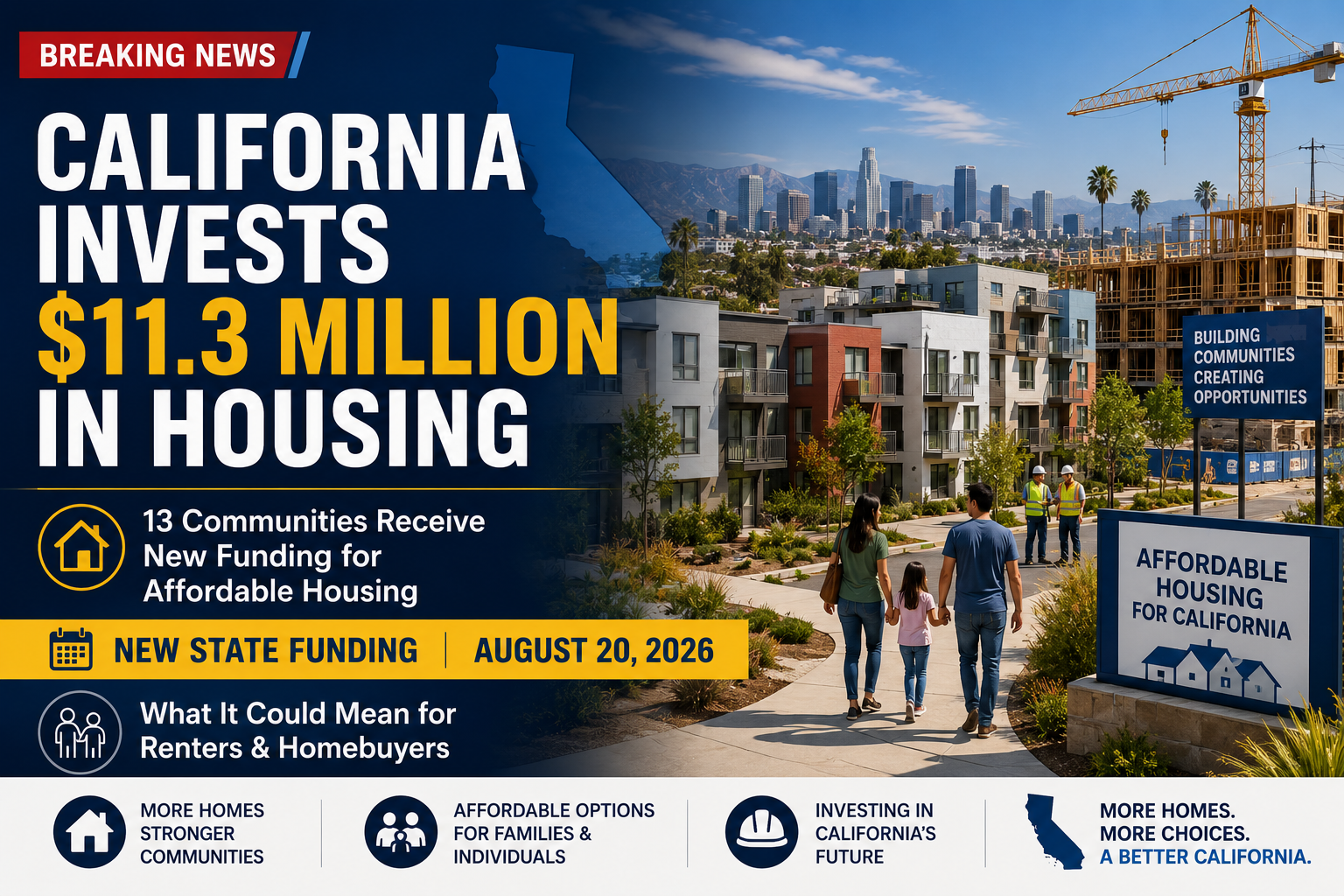
Image note: The image used with this article is AI-generated for illustrative purposes only and does not represent an actual California neighborhood, property, person, or event.