









By CalNews360 Staff
Published: August 21, 2026
A major new plan for managing the Colorado River was released Friday, August 21, as federal officials move to establish new rules for one of the most important water sources in the American West.
The development matters to California because the Colorado River supplies water to communities, farms and businesses across the state—and roughly 40 million people across the broader region depend on the river.
The new federal framework establishes how the river’s major reservoirs will be managed during the next phase of operations, while longer-term disagreements among the states remain unresolved.
Why this matters to California
The Colorado River is one of California’s major sources of water.
It supports communities and agricultural regions in Southern California and is particularly important for areas that depend on imported water.
California officials say the state has already reduced its use of Colorado River water to its lowest level since 1949.
But the pressure on the river is increasing.
The federal Bureau of Reclamation says the Colorado River Basin has experienced 26 years of unprecedented drought, with historically low runoff and reservoir levels.
Lake Mead and Lake Powell reach record-low levels
The situation is particularly concerning because the two largest reservoirs in the system—Lake Mead and Lake Powell—reached record-low elevations in August 2026.
Federal officials say combined storage in the two reservoirs is now lower than it has been since before Lake Powell began filling in 1963.
That doesn’t mean California residents are suddenly going to turn on their taps and find no water.
But it does highlight why water managers are increasingly focused on conservation and long-term planning.
What did the federal government announce?
The U.S. Department of the Interior has adopted a Decision Framework covering Colorado River operations through 2036.
Under the new framework, operating guidelines will generally be established in two-year intervals, unless the states reach longer-term agreements.
The federal government has also issued specific operating guidelines for 2027 and 2028.
Those guidelines will determine how Lake Powell and Lake Mead are operated during those two years.
California says the plan is only a short-term solution
California Gov. Gavin Newsom welcomed the federal action but warned that the new plan does not solve the underlying problem.
Newsom said the two-year operating plan provides only short-term stability and argued that the seven Colorado River Basin states need to continue working toward a durable long-term agreement.
The seven states are:
- California
- Arizona
- Colorado
- Nevada
- New Mexico
- Utah
- Wyoming
Mexico is also part of the broader Colorado River system.
Could this affect California water bills?
Not immediately.
Today’s announcement does not mean California households will suddenly receive a new water bill or face an immediate mandatory reduction in household water use.
Instead, the new operating rules are part of a much larger water-management process.
However, continued shortages on the Colorado River could eventually influence water agencies, agricultural users and communities that depend heavily on imported supplies.
That is why California officials are pushing for conservation and a longer-term agreement.
Why is the Colorado River under so much pressure?
The river has been dealing with a combination of prolonged drought, declining reservoir levels and increasing pressure from communities, farms and other water users.
Climate change is also making the situation more difficult.
California’s governor described the situation as a regional water crisis in Friday’s statement, saying that “every drop of water count[s].”
The challenge is that the river has to serve multiple states and millions of people while the amount of available water has become increasingly uncertain.
What happens next?
The new operating framework takes effect as the region moves into the next phase of Colorado River management.
The federal government says the new guidelines for 2027 and 2028 are intended to provide predictable operations while the broader system continues to adapt to drought and changing water conditions.
At the same time, the seven basin states will continue negotiating over how the river should be managed beyond the immediate two-year period.
What should California residents do?
For most residents, there is no immediate action required because of today’s announcement.
But the development is another reminder that water conservation remains important in California.
Simple measures such as fixing leaks, reducing unnecessary outdoor watering and following local water-use rules can help communities manage supplies during periods of drought.
Residents should also pay attention to announcements from their local water agencies because water restrictions and conservation requirements can vary by community.
The bottom line
A new federal framework for managing the Colorado River was released today, August 21, 2026, as the West faces historically low reservoir levels and continuing drought pressure.
California says the plan provides needed short-term stability but argues that the seven basin states still need a longer-term solution.
For California households, there is no immediate new water restriction announced as a result of today’s decision.
But with Lake Mead and Lake Powell at record-low elevations, the Colorado River’s future is becoming an increasingly important issue for California’s water supply.
Sources: U.S. Department of the Interior/Bureau of Reclamation and Governor of California.
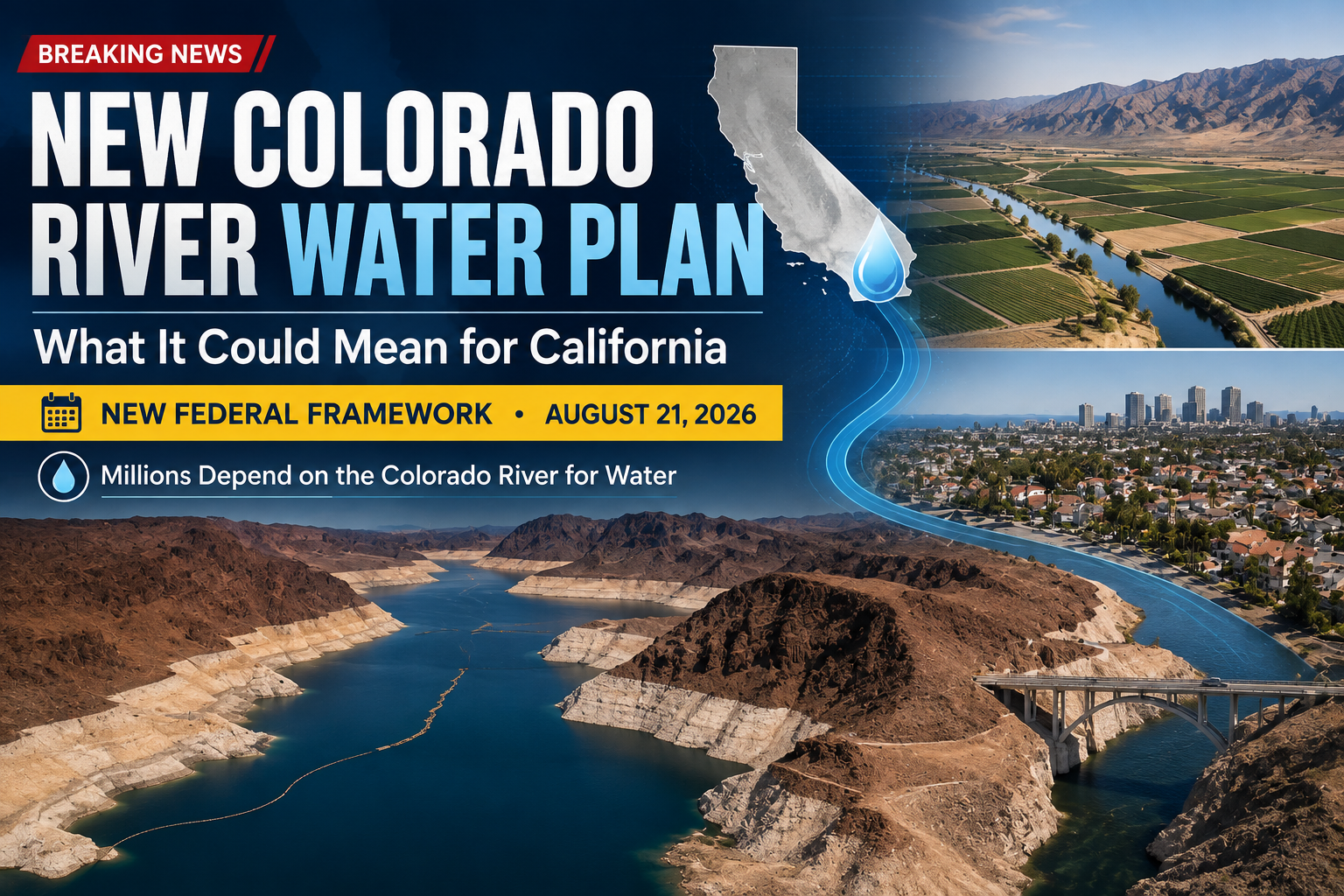
Image note: The image used with this article is AI-generated for illustrative purposes only and does not represent an actual reservoir, water shortage event, government meeting, or individual.