





By CalNews360 Staff
Published: August 22, 2026
Thousands of California homeowners and other property owners in five counties have received a temporary layer of protection against wildfire-related insurance cancellations and non-renewals following the Gann Fire.
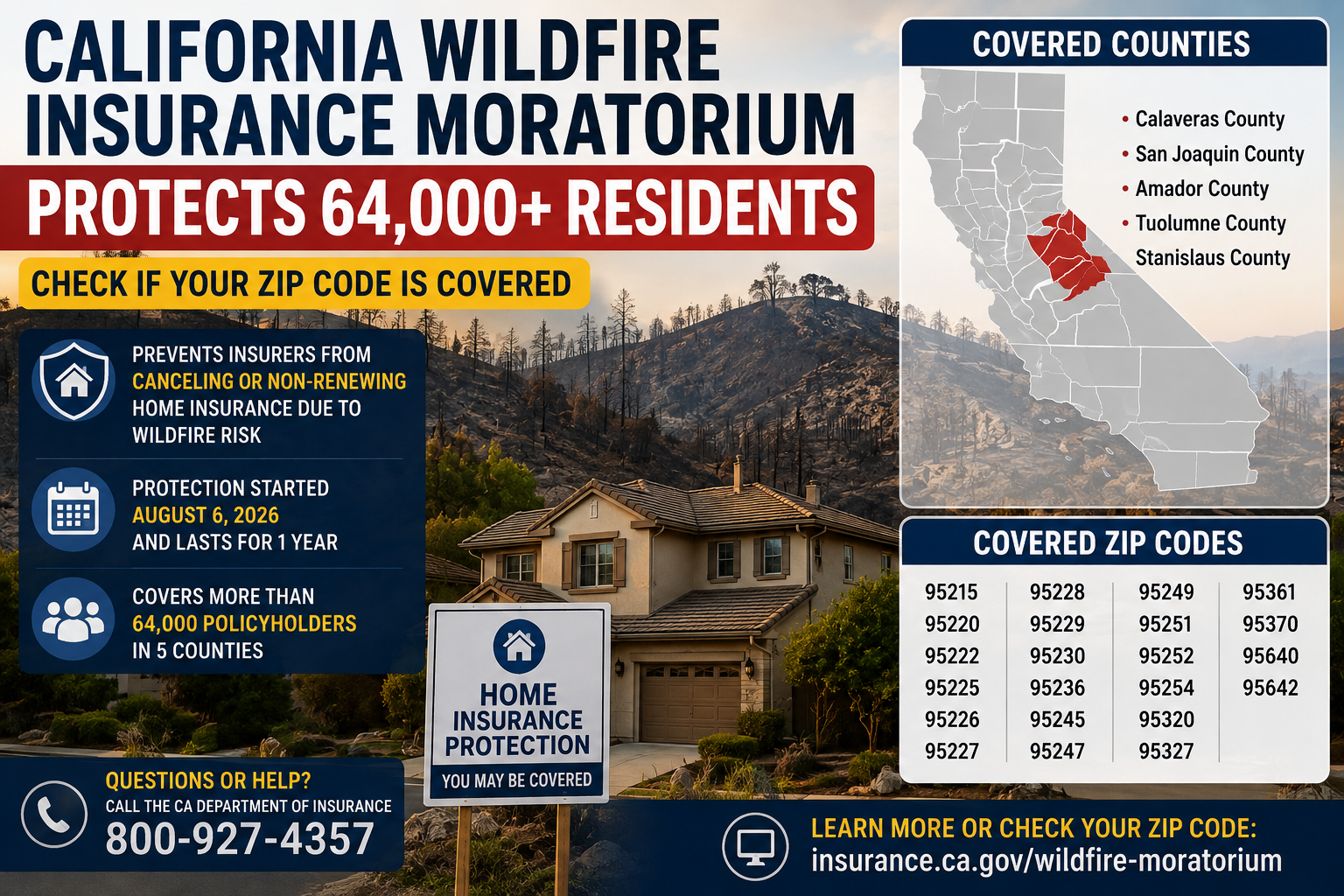
California Insurance Commissioner Ricardo Lara ordered insurers to preserve coverage for more than 64,000 policyholders in areas affected by the fire. The protection covers properties within the fire perimeter and adjoining ZIP codes and lasts for one year from Gov. Gavin Newsom’s August 6, 2026 emergency declaration.
The protection is particularly important for Californians who have been worried about losing homeowners insurance as wildfire risk continues to affect the state’s insurance market.
But there is an important detail: the moratorium does not apply to every California homeowner. It applies to properties in specific ZIP codes connected to the Gann Fire.
What Happened?
The Gann Fire started on August 3, 2026, near Hogan Dam Road and Gann Road in Valley Springs, Calaveras County.
According to CAL FIRE, the fire burned 10,339 acres and was reported 100% contained on August 12. The cause was listed as equipment.
On August 6, Gov. Newsom declared a state of emergency for the Gann Fire.
That declaration triggered California’s wildfire insurance protection process. The California Department of Insurance then worked with CAL FIRE and the Governor’s Office of Emergency Services to identify the affected fire perimeter and adjoining ZIP codes.
On August 14, Insurance Commissioner Ricardo Lara announced the one-year moratorium protecting more than 64,000 policyholders.
What Does the Insurance Moratorium Actually Do?
The moratorium prevents insurance companies from canceling or refusing to renew residential property insurance because of wildfire risk for eligible properties located in the protected areas.
The protection began on August 6, 2026 and runs for one year.
That means an eligible policyholder generally receives protection through August 6, 2027 from wildfire-risk-based cancellation or non-renewal.
The protection is important because homeowners do not have to have suffered damage from the fire to qualify.
California’s Department of Insurance says the one-year protection applies to residential policyholders in affected areas who suffer less than a total loss, including people who suffer no loss at all.
However, the protection is specifically related to wildfire-risk cancellations and non-renewals. It should not be interpreted as a blanket prohibition against every possible insurance cancellation for every possible reason.
Is Your ZIP Code Covered?
For the Gann Fire, the protected area covers 22 ZIP codes.
The ZIP codes listed in the applicable insurance bulletin are:
95215, 95220, 95222, 95225, 95226, 95227, 95228, 95229, 95230, 95236, 95245, 95247, 95249, 95251, 95252, 95254, 95320, 95327, 95361, 95370, 95640 and 95642.
The affected ZIP codes span parts of:
- Calaveras County
- San Joaquin County
- Amador County
- Tuolumne County
- Stanislaus County
If your property is located in one of these ZIP codes, you should check the California Department of Insurance’s official moratorium information before assuming your policy is outside the protection.
What If You Already Received a Non-Renewal Notice?
This is one of the most important parts of the new protection.
If an insurer issued a cancellation or non-renewal notice because of wildfire risk after the August 6 emergency declaration and the property is in one of the protected ZIP codes, insurers must offer to rescind the notice and offer to reinstate or renew the policy as required under the commissioner’s bulletin.
In other words, homeowners who received a wildfire-related notice should not simply assume they have to accept the loss of coverage.
If you received such a notice, keep copies of:
- Your insurance policy
- The cancellation or non-renewal notice
- Letters or emails from your insurer
- Any correspondence explaining the reason for the cancellation
- Your property’s ZIP code and address information
Then contact your insurance company and the California Department of Insurance if necessary.
What If Your Insurance Was Canceled Before August 6?
The new moratorium does not automatically solve every insurance problem.
The California Department of Insurance specifically advises consumers who were non-renewed before the emergency declaration and are having difficulty obtaining insurance to contact the department for assistance in understanding their options.
So if you lost coverage before August 6, you should still contact the Department of Insurance rather than assuming the new moratorium automatically reinstates your old policy.
What About Renters and Condo Owners?
California’s mandatory wildfire insurance protections can involve different types of residential policies.
The department’s current moratorium guidance explains that the law applies to residential policyholders in the affected areas, while the 2026 Gann Fire bulletin also expands protection to certain commercial property policies.
The exact policy type and circumstances matter, so renters, condo owners and other policyholders should verify their individual situation with their insurer or the Department of Insurance.
A New Protection Also Covers Some Commercial Properties
There is another significant change that Californians may not realize.
For the first time under this type of wildfire moratorium, certain commercial property insurance policies are included.
The protection can cover qualifying properties such as:
- Homeowners associations
- Apartment complexes
- Senior living facilities
- Certain other real property used primarily for residential or habitational purposes
The commercial protection applies within the same affected perimeter and adjoining ZIP codes.
That could matter to thousands of residents indirectly because insurance problems affecting apartment buildings, HOAs and other residential properties can ultimately affect housing costs and availability.
Why Is This Important for California Homeowners?
Wildfire insurance has become one of the biggest concerns for homeowners in fire-prone parts of California.
A homeowner can have a property that has never burned but still face difficulty finding or keeping insurance because of the property’s wildfire risk.
California’s mandatory moratorium law was designed to provide temporary breathing room after a declared wildfire emergency.
The Department of Insurance says the protection recognizes that insurance non-renewals can create additional disruption for communities recovering from wildfires.
The state says similar moratorium actions protected more than 1.2 million homeowners during 2025 under California’s residential moratorium law.
What Should Homeowners Do Now?
If you live in one of the 22 ZIP codes, don’t wait until your next renewal date to find out whether you are protected.
1. Check your ZIP code
Compare your property’s ZIP code with the list above.
You can also use the California Department of Insurance’s official moratorium information to check whether your area is included.
2. Check your insurance documents
Look at your most recent policy and any recent notices from your insurance company.
Pay particular attention to cancellation or non-renewal notices that mention wildfire risk.
3. Don’t ignore a non-renewal letter
If you receive a notice, contact your insurer and ask exactly why the policy is being canceled or not renewed.
4. Keep everything in writing
Save emails, letters, notices and responses from the insurance company.
This can be important if you need to demonstrate that a cancellation or non-renewal was connected to wildfire risk.
5. Contact the state if you believe your insurer violated the moratorium
The California Department of Insurance says consumers can contact the department if they believe an insurance company is violating the law.
The consumer assistance number is 800-927-4357. The department also offers online assistance through its website.
What If Your Home Was Completely Destroyed?
Homeowners who suffered a total property loss have additional protections under California law.
The Department of Insurance says those homeowners can have up to 24 months of protection from non-renewal or cancellation.
This is separate from the one-year moratorium protecting properties in and around the declared wildfire area.
The Gann Fire Is Contained — So Why Does the Insurance Protection Continue?
The fire itself is no longer an active emergency response operation.
CAL FIRE reported the Gann Fire fully contained on August 12 after burning more than 10,000 acres.
But insurance problems can continue long after firefighters leave.
Homeowners may still be dealing with property inspections, repairs, claims, rebuilding decisions and questions about whether they can maintain coverage.
That’s why the insurance moratorium lasts for a full year rather than ending when the fire is declared contained.
What Happens Next?
The California Department of Insurance will continue working with CAL FIRE and Cal OES to identify wildfire perimeters and ZIP codes following future gubernatorial emergency declarations.
The department says additional ZIP codes can be added when information about a fire perimeter becomes available.
For homeowners in wildfire-prone areas, that means the department’s official moratorium page is worth bookmarking.
The Bottom Line
More than 64,000 California policyholders are protected from wildfire-risk-related insurance cancellations and non-renewals following the Gann Fire.
The protection applies to 22 ZIP codes across parts of Calaveras, San Joaquin, Amador, Tuolumne and Stanislaus counties and runs for one year from August 6, 2026.
The most important thing for homeowners is to check their ZIP code and understand why their insurer may be canceling or refusing to renew a policy.
If you are in a protected ZIP code and receive a wildfire-related cancellation or non-renewal notice, don’t ignore it. Contact your insurer and, if necessary, the California Department of Insurance at 800-927-4357.
California’s insurance moratorium does not solve the state’s broader wildfire insurance crisis, but for tens of thousands of homeowners, it provides valuable time to maintain coverage while they figure out what comes next.
Sources: California Department of Insurance; California Department of Forestry and Fire Protection (CAL FIRE); California Governor’s Office; California insurance moratorium guidance.
Image note: The image used with this article is AI-generated for illustrative purposes only and does not represent the actual Gann Fire, affected properties, homeowners, insurance officials or specific locations.