








California has abruptly canceled settlement talks with Paramount Skydance over its proposed acquisition of Warner Bros. Discovery, creating a fresh setback for the $110 billion Hollywood deal and raising new questions about whether the transaction can move forward.
California Attorney General Rob Bonta’s office canceled a meeting that had been scheduled for Monday, August 24, to begin preliminary discussions about a possible settlement to California’s lawsuit seeking to block the acquisition.
The move came after California officials accused Paramount of leaking information from a previous meeting and acting in bad faith, according to reporting published Monday.
The latest development is significant because the talks were expected to provide a possible path toward resolving California’s opposition to the deal without waiting for a lengthy court battle.
Instead, the negotiations have started with a major breakdown.
Why Did California Cancel the Paramount Talks?
The immediate dispute centers on what happened during a preliminary meeting between Paramount representatives and California officials on Friday.
According to reporting from Reuters and the New York Times, Bonta’s office became concerned that information from that meeting had been leaked.
California officials subsequently canceled Monday’s planned settlement meeting, accusing Paramount of acting in bad faith.
Bonta’s office has indicated that it remains willing to engage with Paramount if the company approaches the negotiations seriously.
The cancellation does not automatically mean negotiations are permanently over, but it represents a sharp deterioration in the relationship between the two sides at a crucial moment for the transaction.
What Is California Trying to Stop?
Paramount Skydance is seeking to acquire Warner Bros. Discovery in a deal valued at roughly $110 billion.
The proposed transaction would combine two of Hollywood’s biggest entertainment companies and bring a huge collection of film, television and streaming assets under one corporate structure.
The combined company would include major properties associated with Paramount and Warner Bros. Discovery, including:
- Paramount Pictures
- Warner Bros.
- Paramount+
- HBO Max
- CNN
- CBS-related assets
- Major cable television networks
- Extensive movie and television libraries
The size of the transaction has made it one of the most closely watched media deals in years.
But California and other states argue that the combination could reduce competition across several parts of the entertainment industry.
Why Is California Fighting the Merger?
California Attorney General Rob Bonta and attorneys general from other states have challenged the transaction on antitrust grounds.
Their argument is that combining Paramount and Warner Bros. Discovery could give the resulting company too much influence over movie distribution, theatrical releases and television programming.
California’s lawsuit argues that the merger could affect competition in areas including theatrical films and basic cable programming.
The concern extends beyond Hollywood studios.
Critics of the deal have argued that a more concentrated entertainment industry could eventually affect:
- Movie theaters
- Streaming customers
- Cable subscribers
- Independent filmmakers
- Production workers
- Actors and writers
- Advertising markets
- Content distribution
Paramount has rejected the argument that the transaction would harm competition and has continued pushing for the acquisition.
Why Today’s Cancellation Matters
The scheduled settlement meeting was important because it represented a potential opportunity to resolve the dispute outside of a full antitrust trial.
Now that meeting has been canceled.
That creates another obstacle for Paramount at a time when the company is already under pressure to complete the transaction.
The deal is facing litigation from a coalition of states, including California, and a federal antitrust trial is currently scheduled for March 2027 if the legal dispute is not resolved earlier.
That gives both sides an incentive to find a solution — but the collapse of Monday’s meeting shows that reaching an agreement may be difficult.
Could California Still Approve the Deal?
Potentially, but California has made clear that it wants significant protections.
Recent reporting indicates that California officials may seek structural concessions from Paramount before considering a settlement.
Among the issues reportedly under consideration are potential divestitures of certain cable channels and safeguards designed to keep Warner Bros.’ movie studio operations sufficiently independent.
That would be a much more complicated arrangement than simply obtaining promises about future movie production.
California’s position is that behavioral promises alone may not adequately address its antitrust concerns.
What Does Paramount Want?
Paramount wants to complete the Warner Bros. Discovery acquisition without major structural changes that would undermine the economic rationale of the transaction.
The company has argued that the combined business could become a stronger competitor in the global entertainment market.
Paramount has also emphasized commitments surrounding theatrical movie production.
The company has reportedly discussed a commitment to release approximately 30 films per year, a pledge intended to address concerns from movie theaters and other industry participants.
But California officials have indicated that such promises may not be enough.
The dispute therefore comes down to a fundamental question:
Can Paramount offer enough concessions to satisfy California without changing the deal so dramatically that the acquisition no longer makes financial or strategic sense?
Paramount Faces a Costly Delay
Time is becoming increasingly important.
Paramount faces financial consequences if the Warner Bros. transaction continues to be delayed.
The company has estimated that so-called ticking fees could reach millions of dollars per day if the deal is not completed by the contractual deadline.
Reuters previously reported that Paramount estimated the delay-related costs could reach more than $1 billion under certain scenarios.
That creates pressure on Paramount to find a resolution.
But California has its own incentive to hold firm.
If the state believes the merger would substantially reduce competition, officials have little reason to accept a settlement that they consider inadequate simply because Paramount faces rising costs.
Could Paramount Leave California?
Another major issue hanging over the negotiations is Paramount’s future in California.
Paramount CEO David Ellison has previously warned that the company could consider moving significant operations outside California if the regulatory and political environment becomes too difficult.
Reports have also surfaced about possible expansion or relocation plans outside the state.
That possibility has raised concerns among California officials and entertainment-industry workers.
Paramount’s Hollywood presence supports thousands of jobs directly and indirectly through production, post-production, entertainment services and related businesses.
A major relocation could therefore have consequences extending far beyond Paramount itself.
What Would a Paramount-Warner Bros. Merger Mean for Hollywood Jobs?
This is one of the biggest questions surrounding the deal.
Mergers of major entertainment companies often lead to restructuring, elimination of duplicate positions and reductions in operating costs.
Paramount and Warner Bros. Discovery both operate large corporate, production, distribution and media businesses.
Combining them could create significant overlap.
That has raised concerns among Hollywood workers who are already dealing with a difficult employment environment.
The Writers Guild of America has also challenged the transaction, arguing that the merger could harm workers and competition.
For California, the jobs issue adds another dimension to the antitrust fight.
The debate is not simply about which company owns which studio.
It is also about what the future Hollywood workforce will look like.
What Happens Next?
The immediate question is whether Paramount and California will return to negotiations.
Today’s cancellation does not necessarily mean the parties will never speak again.
However, the accusation of bad faith makes the path to a quick settlement more difficult.
California could continue pursuing its lawsuit while remaining open to negotiations if Paramount presents more substantial concessions.
Paramount, meanwhile, has to decide whether making additional concessions would be preferable to allowing the litigation to continue.
The March 2027 federal trial remains a major potential milestone if no settlement is reached.
Could the Deal Still Go Through?
Yes.
Today’s cancellation does not kill the Paramount-Warner Bros. transaction.
The proposed acquisition remains alive, but it now faces another significant obstacle.
The transaction has already received important regulatory approvals outside the states challenging the deal, but California and other states continue to pursue their antitrust case.
That means Paramount still has several paths available:
- Negotiate a settlement with California and other states.
- Continue fighting the state lawsuit in court.
- Offer additional structural concessions.
- Attempt to proceed after successfully defeating the legal challenge.
Each option carries financial and strategic risks.
Why This Matters to California
For Californians, the dispute is about more than two entertainment companies.
Hollywood remains an important part of the state’s economy, particularly in Los Angeles.
A major restructuring of Paramount and Warner Bros. Discovery could affect production decisions, studio employment, post-production work, independent filmmakers and the broader entertainment-services economy.
There is also a larger question about whether California can continue to remain the center of the American entertainment industry as studios consider locations in other states.
If Paramount ultimately moves significant operations elsewhere, the merger dispute could become part of a much larger debate over California’s competitiveness.
The Bigger Question: Is Hollywood Becoming Too Consolidated?
The Paramount-Warner Bros. fight reflects a broader transformation taking place throughout entertainment.
Streaming has already changed how movies and television shows are financed, distributed and consumed.
Traditional television audiences have declined, while streaming companies have become major competitors for Hollywood studios.
At the same time, entertainment companies are under pressure to reduce costs and produce content more efficiently.
That environment is encouraging consolidation.
But every major merger raises the same question:
Does a larger entertainment company become a stronger competitor — or does it simply give one company too much control?
That is ultimately what California and the other states challenging the deal want the courts to decide.
What Today’s Development Means
The most important takeaway from today’s news is that the settlement process has hit a major roadblock, but the merger itself has not been canceled.
California was supposed to meet with Paramount representatives on Monday to explore whether the state’s lawsuit could be resolved.
Instead, the meeting was canceled after California officials accused Paramount of leaking information and acting in bad faith.
That leaves the two sides further apart at a moment when Paramount is facing increasing pressure to close the transaction.
For Hollywood, California and the thousands of workers connected to the entertainment industry, what happens next could have consequences well beyond this one corporate deal.
The Bottom Line
California has canceled planned settlement talks with Paramount Skydance over its proposed $110 billion acquisition of Warner Bros. Discovery, creating a new setback for the transaction.
The cancellation follows accusations from Attorney General Rob Bonta’s office that Paramount leaked information from an earlier meeting and acted in bad faith.
The deal is not dead, but the latest breakdown makes a quick settlement more difficult.
The next major question is whether Paramount will offer the structural concessions California is seeking — or whether the two sides will continue toward a court battle.
For California’s entertainment industry, the stakes are enormous.
The world’s attention may be on the $110 billion price tag, but for Hollywood, the bigger question is what happens to the studios, jobs and creative businesses that remain at the heart of California’s entertainment economy.
Source Notes
This article is based on fresh reporting published August 24, 2026, including Reuters’ report on California’s cancellation of the settlement meeting and current reporting from Variety and other entertainment-industry sources.
AI Image Disclosure
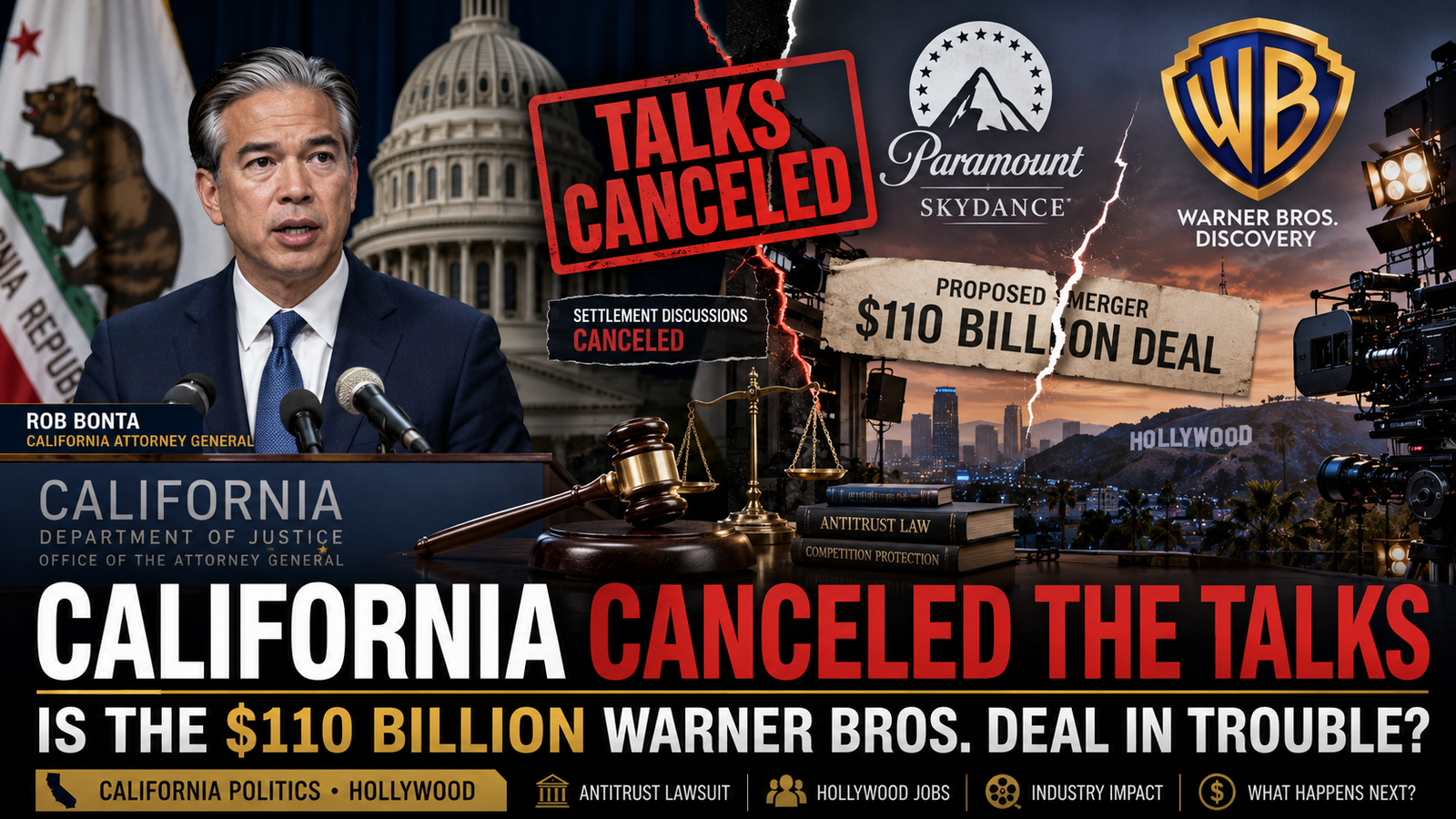
Image Disclaimer: The featured image in this article was generated using artificial intelligence (AI) for illustrative and editorial purposes. It does not depict an actual Paramount-Warner Bros. settlement meeting or government proceeding.