








California has approved the nation’s first statewide efficiency standards for replacement tires, a major change that could eventually affect what millions of drivers can buy when it is time to replace their tires.
The California Energy Commission unanimously approved the Replacement Tire Efficiency Program (RTEP), which establishes rolling-resistance and wet-grip requirements for replacement tires sold for passenger vehicles and light-duty trucks. The first requirements begin in 2029, with stricter standards taking effect in 2033.
The state says the program could save Californians nearly $1 billion a year in gasoline and electricity costs and reduce carbon dioxide emissions by approximately 2 million metric tons annually.
But the new rules are already generating a fierce debate.
Tire manufacturers and industry representatives warn that the regulations could reduce consumer choice, increase costs and create enforcement problems involving imported tires. The California Energy Commission, meanwhile, says the rules were developed after years of testing and stakeholder discussions and that compliant tires are already available.
For California drivers, the obvious question is:
When you need your next set of tires, will you still be able to buy the ones you want?
The New Rules Don’t Start Tomorrow
First, there is an important point for drivers who may be worried about needing to change their tires immediately:
Nothing changes for the tires you are buying today.
The first phase of the program begins in 2029, while the full standard takes effect in 2033.
That gives tire manufacturers several years to redesign products that do not currently meet the requirements.
The rules apply primarily to replacement tires, meaning the tires drivers purchase after the original equipment tires on a vehicle need to be replaced.
The program is not simply a requirement that every tire on every new vehicle sold in California suddenly meet a new standard.
Why Is California Regulating Replacement Tires?
The California Energy Commission says there is an efficiency gap between the tires installed on new vehicles and many replacement tires sold afterward.
New vehicles are often equipped with tires designed to reduce rolling resistance.
Rolling resistance is essentially the energy lost as a tire deforms against the road and then returns to its shape while rotating.
Lower rolling resistance generally means a vehicle requires less energy to move.
For gasoline vehicles, that can translate into better fuel economy.
For electric vehicles, it can help improve energy efficiency and potentially driving range.
The CEC says replacement tires have historically been less efficient on average, meaning some drivers lose fuel economy or EV range after replacing their original tires.
The new program is intended to reduce that gap.
How Much Could California Drivers Save?
The state’s estimate is substantial.
The CEC projects that the program could eventually save California drivers approximately $1 billion annually in gasoline and electricity costs.
For an individual gasoline-vehicle owner, the commission estimates approximately $179 in fuel savings over the life of a set of tires under the program’s assumptions.
The agency also estimates the regulations could reduce annual carbon dioxide emissions by about 2 million metric tons — an amount it compares with removing approximately 400,000 gasoline-powered cars from California roads.
Those numbers are based on the state’s modeling and assumptions, including fuel prices, tire efficiency and driving patterns.
But There Is a Catch: Tire Choice
This is where the controversy begins.
Industry representatives have warned that the new standards could eliminate a significant number of replacement-tire models from the California market.
Goodyear, for example, has argued that the regulations could eliminate roughly 70% of currently available replacement tires and potentially increase upfront costs. That is an industry estimate, not a finding by the California Energy Commission.
The CEC presents a considerably different picture.
The agency says many tires already meet the requirements and that manufacturers have years to adjust products that do not.
The commission also says its testing found no adverse trade-offs involving tire lifespan, safety or other characteristics.
That disagreement is likely to remain at the center of the debate.
Will Your Tires Become More Expensive?
The state says the additional cost should be relatively small.
According to the CEC, the estimated incremental cost is approximately:
- $1.50 per tire during Phase 1
- $6.50 per tire during Phase 2
The commission estimates that a typical gasoline vehicle owner could save substantially more in fuel over the life of the tires.
The San Francisco Chronicle reported a somewhat different way of presenting the same issue, estimating approximately $6 per set under the 2029 standard and $26 per set under the 2033 standard, while the CEC projects lifetime savings of approximately $85 and $179 respectively under its analysis.
So the state’s argument is essentially:
Pay slightly more for the tire, then save more through lower energy consumption.
Critics question whether the actual market will behave that cleanly.
Why Are Tire Companies Worried?
The industry’s concerns go beyond the price of individual tires.
Manufacturers and dealers have raised questions about:
- Consumer choice
- Manufacturing costs
- Enforcement
- Imported tires
- Availability of specialty tires
- Performance characteristics
- Whether the projected savings will materialize
One particularly important issue is enforcement.
The regulation contains an exemption for companies producing or importing fewer than 15,000 tires per year, according to the San Francisco Chronicle’s reporting on the rule. Industry representatives have argued that such an exemption could create an advantage for lower-cost imported tires that do not face the same requirements.
That could become an important issue as California begins implementing the program.
What About Tire Safety?
This is perhaps the most sensitive part of the debate.
A tire has to do much more than roll efficiently.
Drivers depend on tires for:
- Braking
- Cornering
- Wet-road traction
- Emergency maneuvers
- Highway stability
- Heat resistance
- Load carrying
Critics of the regulation have questioned whether emphasizing low rolling resistance could compromise performance.
But the California Energy Commission says safety was considered in developing the standards.
The final program includes wet-grip requirements, and the commission says its testing found no adverse safety trade-offs.
That is important because the rule is not simply a mandate for tires to have the lowest possible rolling resistance.
The program combines efficiency requirements with performance standards.
California Is Not Banning Every High-Performance Tire
Another misconception is that California will simply eliminate every performance-oriented tire.
The final program includes exemptions and special categories for certain tire types.
The CEC specifically says exceptions include some:
- Competition tires
- Large off-road tires
- All-weather winter performance tires
The program also creates categories for specialized products such as ultra-high-performance tires, long-life tires and low-load-index tires.
That means the final rules are more complicated than simply saying:
“California is banning performance tires.”
That would be inaccurate.
What About SUVs and Trucks?
The rules cover replacement tires for passenger vehicles and light-duty trucks.
That makes the program relevant to a huge number of California vehicles, from compact sedans and hybrids to SUVs and light trucks.
However, certain specialty categories receive exemptions or special treatment.
Drivers with unusual vehicles or specialized tire requirements will therefore need to check whether their specific tire category is covered when the standards begin taking effect.
What Does This Mean for EV Owners?
Electric-vehicle drivers could have a particular reason to pay attention.
Tire rolling resistance directly affects how much energy an EV needs to travel a given distance.
A more efficient tire can therefore potentially increase driving range.
The CEC says its program is designed to improve efficiency for both gasoline-powered and electric vehicles.
For an EV owner who drives long distances, even relatively small efficiency improvements can add up over thousands of miles.
But EV drivers also have to consider other factors such as tire wear, vehicle weight and manufacturer recommendations.
Efficiency is only one part of choosing the right tire.
Will California Drivers Have Fewer Choices?
Possibly — but the extent is disputed.
Industry groups warn that the rules could significantly reduce the number of tire models available.
The CEC says many compliant tires already exist and that manufacturers have several years to adjust their products.
The San Francisco Chronicle reported that CEC Commissioner Nancy Skinner said approximately 70% of tires available today already comply with the less-stringent 2029 standard, while about 30% meet the standard scheduled for 2033.
Those figures suggest that the market may have substantial room to adapt before the stricter standard arrives.
What Happens in 2029?
The program will be introduced in phases.
Phase One — 2029
The initial efficiency requirement begins.
The first stage is less stringent than the final standard.
Phase Two — 2033
The full, stricter efficiency requirement takes effect.
That longer timeline is intended to give tire manufacturers time to develop and certify products that meet the standards.
So Californians won’t suddenly walk into a tire store in January 2029 and find that every existing model has disappeared overnight.
The market is expected to transition gradually.
Could This Affect Tire Prices Before 2029?
It could, although the size of any impact is uncertain.
Manufacturers may invest in new tire designs and production processes.
Retailers may also adjust inventories as the implementation dates approach.
However, the CEC estimates the direct incremental cost of compliant tires will remain relatively small.
Industry representatives have argued that the real-world impact could be greater.
The difference between those forecasts is something California drivers will be able to judge as the market begins adjusting.
California Says the Rules Could Help at the Gas Pump
California’s argument is ultimately about total ownership cost.
A tire that costs slightly more but improves fuel economy could potentially pay for the difference over time.
The CEC estimates that the lifetime fuel savings for a typical gasoline vehicle could be around $179 per set under the full program.
That calculation assumes gasoline prices of $4.60 per gallon.
The agency says savings could be higher under elevated fuel prices.
For Californians who drive long distances, the economics could therefore be more noticeable.
Why This Is a Big Deal for California
California is the first state in the country to adopt replacement-tire efficiency standards of this kind.
That makes the policy important beyond California.
If the program works, other states could consider similar rules.
If manufacturers face significant difficulties complying, the industry could push for changes before the standards become fully effective.
California’s decision could therefore become a test case for how governments regulate vehicle components that directly affect energy consumption.
Could Other States Follow California?
It is possible.
California has frequently been an early adopter of vehicle and emissions regulations that later influence policies elsewhere.
The replacement-tire program could become another example.
Other states will likely watch:
- Whether tire prices rise
- Whether consumers lose meaningful choice
- Whether fuel savings match projections
- Whether safety concerns emerge
- How effectively the state enforces the standards
- Whether manufacturers can produce compliant tires at scale
If the program delivers the savings California predicts without creating significant problems, it could become a model for other states.
What California Drivers Should Do Now
There is no need to rush out and buy a new set of tires simply because the rule was approved.
The first requirements do not begin until 2029.
Instead, drivers should continue choosing tires based on their vehicle manufacturer’s recommendations, driving conditions and safety needs.
When purchasing tires in the future, it will be worth checking:
- The tire’s efficiency rating
- Wet-weather performance
- Load rating
- Speed rating
- Expected tread life
- Whether the tire is approved for your vehicle
- Whether it complies with California’s requirements once the rules take effect
Drivers should also avoid assuming that the cheapest tire is necessarily the best value.
What About Tires You Already Own?
The new regulations are aimed at tires offered for sale as replacements.
They do not mean Californians need to remove tires from their vehicles simply because those tires would not meet future standards.
The program concerns what can be sold under the new requirements once the applicable standards take effect.
So if you recently purchased a set of tires, there is no reason to replace them because of this rule.
The Bigger Debate: Efficiency vs. Choice
The California tire controversy is really part of a larger debate over how much government should regulate everyday consumer products.
Supporters see the rule as a practical efficiency measure:
Make replacement tires perform more like the efficient tires already installed on new cars, and drivers save money over time.
Critics see a different risk:
Restricting the market could reduce choices and potentially increase prices, particularly for drivers who need specialized tires.
Both sides agree on one thing:
Tires matter.
They affect fuel consumption, EV range, handling, braking and safety.
That is why the transition will be closely watched.
The Bottom Line
California has approved the nation’s first replacement-tire efficiency standards, and the change will eventually affect what many drivers can buy when they replace worn-out tires.
The first phase begins in 2029, followed by a stricter standard in 2033.
The state estimates the program could save Californians nearly $1 billion annually in gasoline and electricity costs and reduce emissions by approximately 2 million metric tons per year.
But tire manufacturers warn that the rules could reduce consumer choice and increase costs, with Goodyear representatives estimating that roughly 70% of currently available replacement tires could eventually be affected. That figure is an industry warning, not the state’s own estimate.
The CEC says the opposite: many compliant tires already exist, the standards include safety-related wet-grip requirements and manufacturers have years to adapt.
For California drivers, the biggest change isn’t happening today. It’s coming in 2029 — and by 2033, the tire aisle at your local store could look very different.
Official & Useful Links
California Energy Commission — Replacement Tire Efficiency Program:
California Energy Commission — Official Tire Efficiency Program
California Energy Commission — Program Documents:
CEC Replacement Tire Efficiency Program Documents
California Energy Commission — Regulatory Docket:
CEC Tire Efficiency Regulatory Docket
Consumer-focused reporting:
San Francisco Chronicle — California tire efficiency rules
Automotive industry coverage:
Autoweek — California’s new replacement tire rules
AI Image Disclosure
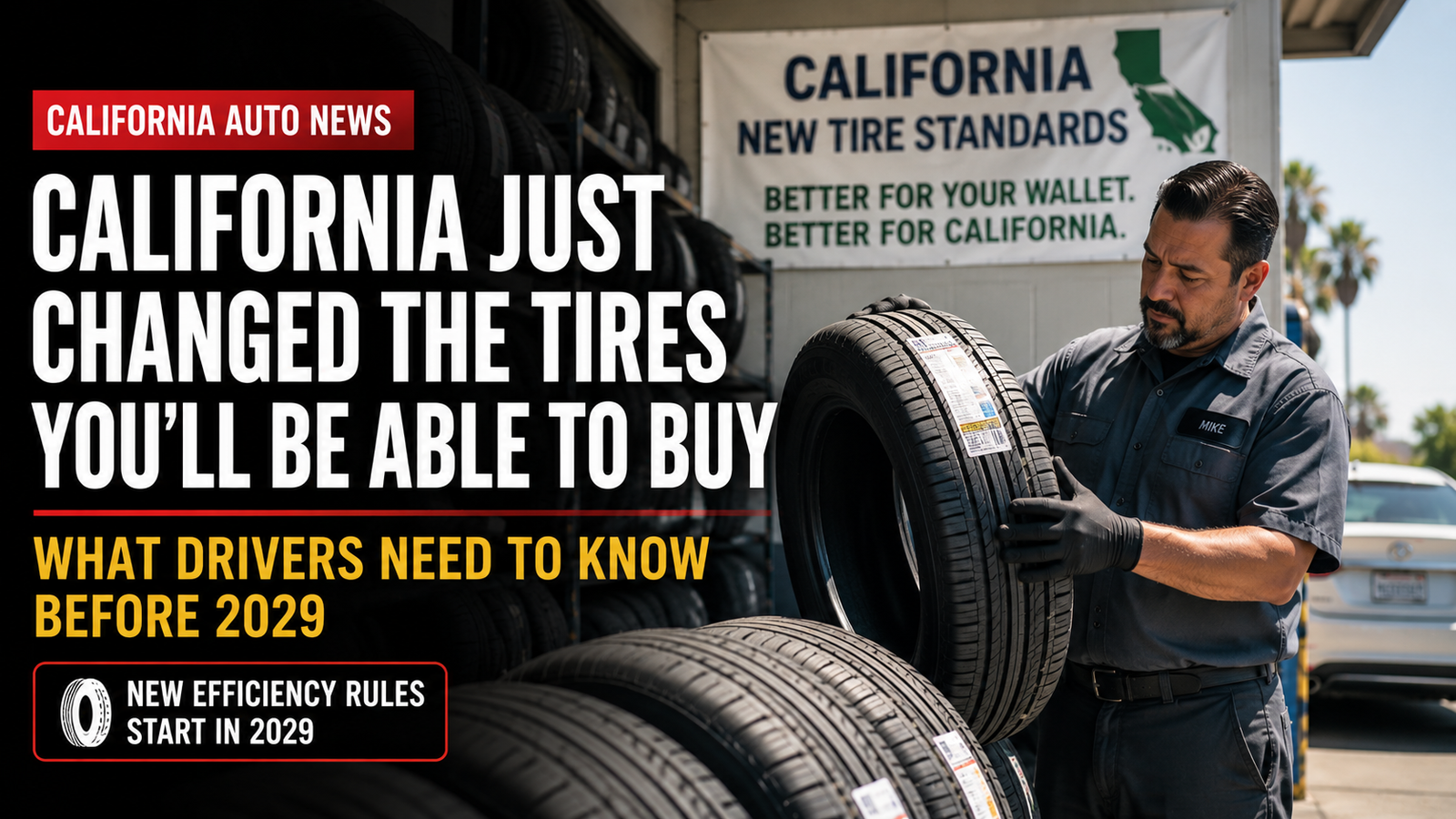
Image Disclaimer: The featured image in this article was generated using artificial intelligence (AI) for illustrative and editorial purposes. It does not depict an actual California tire store, tire manufacturer, vehicle inspection or government proceeding.