








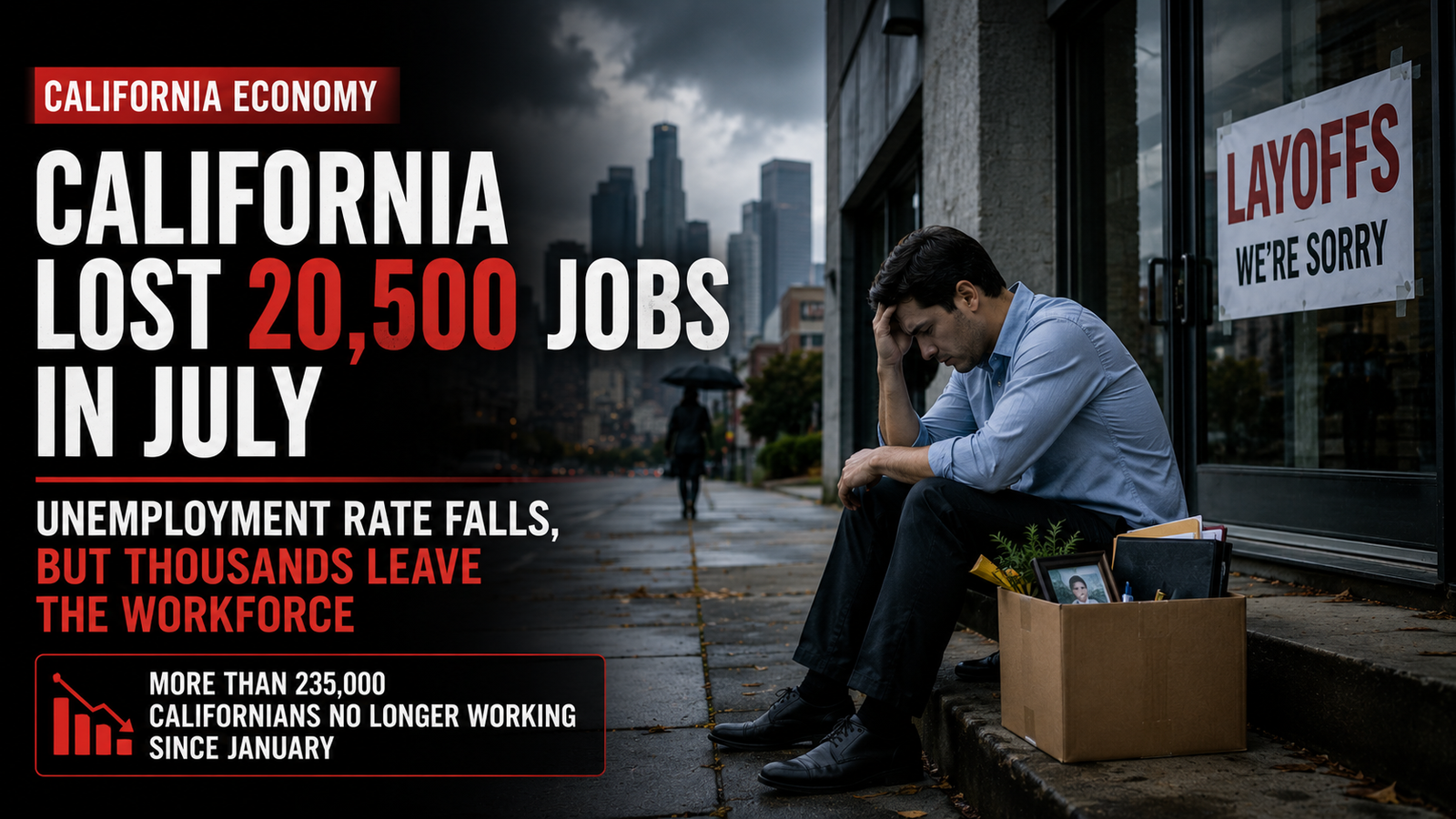
California’s unemployment rate just improved to 5.1%, but the state’s latest employment numbers contain a warning that is easy to miss: California actually lost 20,500 payroll jobs in July, while hundreds of thousands of people have disappeared from the state’s labor force since the beginning of the year.
The July figures, released August 21, present a mixed picture of California’s economy.
On one hand, the state’s unemployment rate fell from 5.2% in June to 5.1% in July, its lowest level since February 2024.
On the other hand, California’s employers reported a net loss of 20,500 payroll jobs in July, and the state’s Legislative Analyst’s Office says the household survey shows an even more concerning trend: the number of Californians working has fallen by more than 235,000 since January, while the labor force has contracted by more than 300,000.
So which number should Californians believe?
The answer is more complicated than the unemployment rate alone suggests.
California’s Unemployment Rate Fell — But Jobs Also Disappeared
The headline number sounds positive.
California’s unemployment rate dropped to 5.1% in July, down from 5.2% in June.
But the state’s payroll survey showed that employers had 18.133 million nonfarm jobs in July, a decline of 20,500 from June.
That means California experienced a month in which the unemployment rate improved while the number of payroll jobs declined.
It sounds contradictory.
But the two statistics measure different things.
The payroll survey counts jobs reported by businesses.
The household survey measures whether people are employed, unemployed or participating in the labor force.
That distinction is critical to understanding what is happening in California.
Why Can Unemployment Fall When Jobs Are Being Lost?
The unemployment rate is calculated using people who are actively participating in the labor force.
If someone loses a job but continues looking for work, that person is counted as unemployed.
But if someone stops looking for work and leaves the labor force, that person is no longer counted as unemployed.
That means the unemployment rate can sometimes fall even when fewer people are working.
California’s Legislative Analyst’s Office says that appears to be an important factor behind the state’s recent improvement in its unemployment rate.
The LAO describes the labor market as soft, noting that the recent decline in unemployment is largely connected to workers leaving the labor force rather than strong job creation.
That is the part of the report that deserves the most attention.
More Than 235,000 Californians Are No Longer Working
According to the LAO’s analysis of the household survey, the number of Californians who are working has fallen by more than 235,000 since January.
The state’s labor force has contracted by more than 300,000 workers over the same period.
That does not mean all of those people lost jobs.
Some may have retired, returned to school, moved out of the state, stopped searching for work or left the labor force for other reasons.
But the scale of the decline is significant enough that economists are paying attention.
California’s labor-force participation rate fell to 61.6% in July, from 61.8% in June. The rate is down 0.8 percentage points over the past year.
California Still Has More Jobs Than a Year Ago
There is another side to the story.
Despite the recent slowdown, California has 112,700 more nonfarm payroll jobs than it did in July 2025, an increase of about 0.6%.
So this is not a straightforward story of California’s economy collapsing.
The state has continued to add jobs over the past year.
The problem is that the growth has become uneven and has slowed significantly in recent months.
California lost 20,500 jobs in July after revised data showed a gain of 6,100 jobs in June. May was revised to a loss of 15,600 jobs.
That means California lost approximately 30,000 jobs across May and July.
July’s decline was also the state’s worst single-month payroll decline since June 2025, according to the San Francisco Chronicle.
Which California Industries Are Losing the Most Jobs?
The biggest July decline came from professional and business services.
That sector lost approximately 15,300 jobs during the month.
The sector includes a wide range of professional occupations, including services connected to business operations, consulting and other professional activities.
Leisure and hospitality also declined sharply, losing approximately 7,400 jobs.
Other sectors reporting monthly declines included:
- Financial activities: -3,600
- Information: -1,900
- Government: -1,400
- Manufacturing: -1,300
- Mining and logging: -100
But several sectors continued adding workers.
Construction Is Still Hiring
California’s construction industry added approximately 2,900 jobs in July.
Trade, transportation and utilities added about 2,800.
Other services added approximately 2,700.
Private education and health services added around 2,100 jobs.
That tells an important story about California’s labor market.
The weakness isn’t being spread evenly across every industry.
Some parts of the economy continue to expand while others are cutting jobs or slowing hiring.
Health Care Remains One of California’s Strongest Job Engines
Private education and health services have been among the strongest areas of California’s economy over the past year.
The sector added approximately 134,700 jobs between July 2025 and July 2026, according to the latest state figures.
That is dramatically larger than the gains seen in most other major sectors.
Leisure and hospitality added about 35,500 jobs over the same period.
Trade, transportation and utilities gained approximately 11,600.
Other services added about 12,100.
But several sectors lost jobs compared with a year earlier.
Information Jobs Are Under Pressure
California’s information sector had approximately 20,000 fewer jobs than a year earlier.
Federal government employment also declined by approximately 17,000 jobs over the same period.
The information-sector decline is particularly significant for California because it includes industries closely associated with technology and digital media.
The state’s technology-heavy economy has been undergoing restructuring as companies shift spending toward artificial intelligence infrastructure and other priorities.
Is AI Causing California’s Job Losses?
This is where the story becomes more complicated.
There have been significant technology layoffs in California this year, but it would be misleading to say that the entire statewide employment decline is caused by artificial intelligence.
California has actually launched a first-in-the-nation AI-Unemployment Tracker to study exactly this question.
The tracker was developed by the California Employment Development Department, California Policy Lab and the Governor’s Office.
As of its initial analysis through May, researchers found no evidence of a statewide surge in layoffs among workers in highly AI-exposed occupations.
However, they did find early signs of disruption among some highly educated workers and in specific regions and industries, particularly the San Francisco Bay Area and professional services.
That means AI may be changing California’s labor market, but the available evidence does not support blaming every job loss on AI.
San Francisco Is Feeling the Pressure
The statewide numbers are especially relevant to the Bay Area.
The San Francisco Chronicle reported that San Francisco’s unemployment rate increased to approximately 3.9%, with job cuts concentrated in areas including government and information.
The Bay Area has traditionally benefited from California’s concentration of high-paying technology and professional jobs.
But that also means it can feel technology-sector restructuring more sharply.
Companies cutting costs, redirecting money toward AI infrastructure and becoming more selective about hiring can have an outsized effect on the region.
California’s Labor Market Isn’t in a Traditional Crisis — Yet
There is an important reason not to overstate the latest numbers.
The state still has:
- More than 112,000 additional payroll jobs compared with a year ago
- A 5.1% unemployment rate
- Continued hiring in health care
- Continued growth in construction
- Continued year-over-year growth in leisure and hospitality
Those numbers do not resemble the kind of broad employment collapse seen during a major recession.
Instead, the evidence points toward a cooling and increasingly uneven labor market.
Employers are still hiring in some industries.
But job seekers may be finding it harder to land positions in other sectors, particularly some professional and technology-related fields.
Why the Labor Force Decline Matters
The labor force figure may ultimately be more important than the unemployment rate.
A shrinking labor force can affect California in several ways.
Fewer people working can mean:
- Lower household income
- Lower consumer spending
- Less tax revenue
- A smaller pool of available workers
- Greater pressure on households supporting unemployed or inactive workers
It can also make the unemployment rate look better than the underlying employment situation actually is.
That doesn’t mean everyone leaving the labor force is experiencing economic hardship.
People leave the workforce for many legitimate reasons.
But a sustained decline deserves attention.
What Does This Mean for California Workers?
For someone already employed, the latest numbers do not necessarily signal that their job is at immediate risk.
But for people searching for work, the environment could be getting more competitive.
The San Francisco Chronicle reported that job listings are attracting large numbers of applicants, with particularly strong competition for well-paid white-collar positions.
That means California’s labor-market problem may be shifting from:
“Are there jobs?”
to:
“Can workers find the right jobs?”
That is a very different problem.
Young and Highly Educated Workers Could Face a Tougher Market
The AI-unemployment research is particularly interesting here.
California’s AI tracker found early signs of increased unemployment claims among college-educated workers in highly AI-exposed occupations, while similarly educated workers in lower-exposure occupations did not show the same pattern.
That doesn’t mean AI is replacing college graduates across California.
But it suggests that some white-collar workers could face more competition as companies rethink hiring and job structures.
Entry-level workers could be particularly vulnerable if companies decide that technology allows them to accomplish more with smaller teams.
Which Workers Are Still in Demand?
The strongest recent employment gains provide some clues.
Health care and social assistance continue to expand.
Construction is also adding workers.
Transportation and utilities have continued to grow.
Those sectors may offer opportunities even while professional and business services are cooling.
But California’s economy is enormous and diverse, so statewide numbers cannot tell an individual worker whether a particular occupation is growing.
Local labor-market data will be more useful for that decision.
What About California’s Overall Economy?
The latest employment report suggests California’s economy is in a strange position.
It is not simply booming.
It is not clearly in recession either.
Instead, some sectors are expanding rapidly while others are contracting.
That creates what economists sometimes describe as a two-speed economy.
Health care continues hiring.
Construction is adding jobs.
But professional services, leisure and hospitality and several other sectors are shrinking.
Meanwhile, the number of people participating in the labor force has fallen.
That combination makes the headline unemployment rate difficult to interpret on its own.
What Happens Next?
The July numbers are preliminary and can be revised.
California’s employment data are based on two separate surveys, and monthly estimates can change as additional information becomes available.
The next major statewide employment release, covering August 2026, is scheduled for September 18.
That report will be important because it will show whether July’s sharp decline was temporary or part of a broader trend.
If payroll employment rebounds, July could look more like a bad month.
If job losses continue, the July report could prove to be an early warning.
What Should Californians Watch?
There are several numbers worth following over the next few months.
1. Payroll employment
Will California recover the 20,500 jobs lost in July?
2. Labor-force participation
Will the number of people working or looking for work continue to decline?
3. Professional and business services
Will the sector continue shedding jobs?
4. Technology employment
Will AI-related restructuring produce larger effects in California?
5. Health care
Can health care continue to offset weakness elsewhere?
6. Consumer spending
If fewer Californians are working, household spending could eventually weaken.
These indicators will help determine whether California is experiencing a temporary slowdown or something more serious.
The Bottom Line
California’s latest jobs report sends a mixed message.
The unemployment rate improved to 5.1%, its lowest level since February 2024.
But at the same time, the state lost 20,500 payroll jobs in July, with professional and business services accounting for the largest monthly decline.
California still has 112,700 more jobs than it did a year ago, so the data do not point to an economy-wide employment collapse.
The bigger concern is the labor force.
The state’s Legislative Analyst’s Office says the number of Californians working has declined by more than 235,000 since January, while the labor force has contracted by more than 300,000.
That is why the falling unemployment rate shouldn’t be viewed as an entirely positive signal.
California’s job market isn’t necessarily falling apart — but it is becoming harder to describe as healthy across the board.
The next few months will reveal whether July was simply a rough patch or the beginning of a deeper slowdown.
For California workers, the most important question may no longer be whether the state has jobs, but where those jobs are — and who is actually getting them.
Official & Verified Sources
California Legislative Analyst’s Office:
California Monthly Jobs Report — July 2026
U.S. Bureau of Labor Statistics:
California Employment & Unemployment — July 2026
California Employment Development Department:
California Labor Market Information & Release Schedule
California AI-Unemployment Tracker:
UCLA California AI-Unemployment Tracker Information
San Francisco Chronicle:
California lost 30,000 jobs in the last three months
AI Image Disclosure
Image Disclaimer: The featured image in this article was generated using artificial intelligence (AI) for illustrative and editorial purposes. It does not depict an actual California workplace, employee, job fair, company office or employment event.