








CALIFORNIA — Californians have a rare reason to look toward the evening sky this week. A nearly total lunar eclipse will sweep across the Moon on Thursday night, August 27, turning most of the full Moon a deep copper-red as Earth’s shadow moves across its surface.
This isn’t technically a total lunar eclipse.
But it will come surprisingly close.
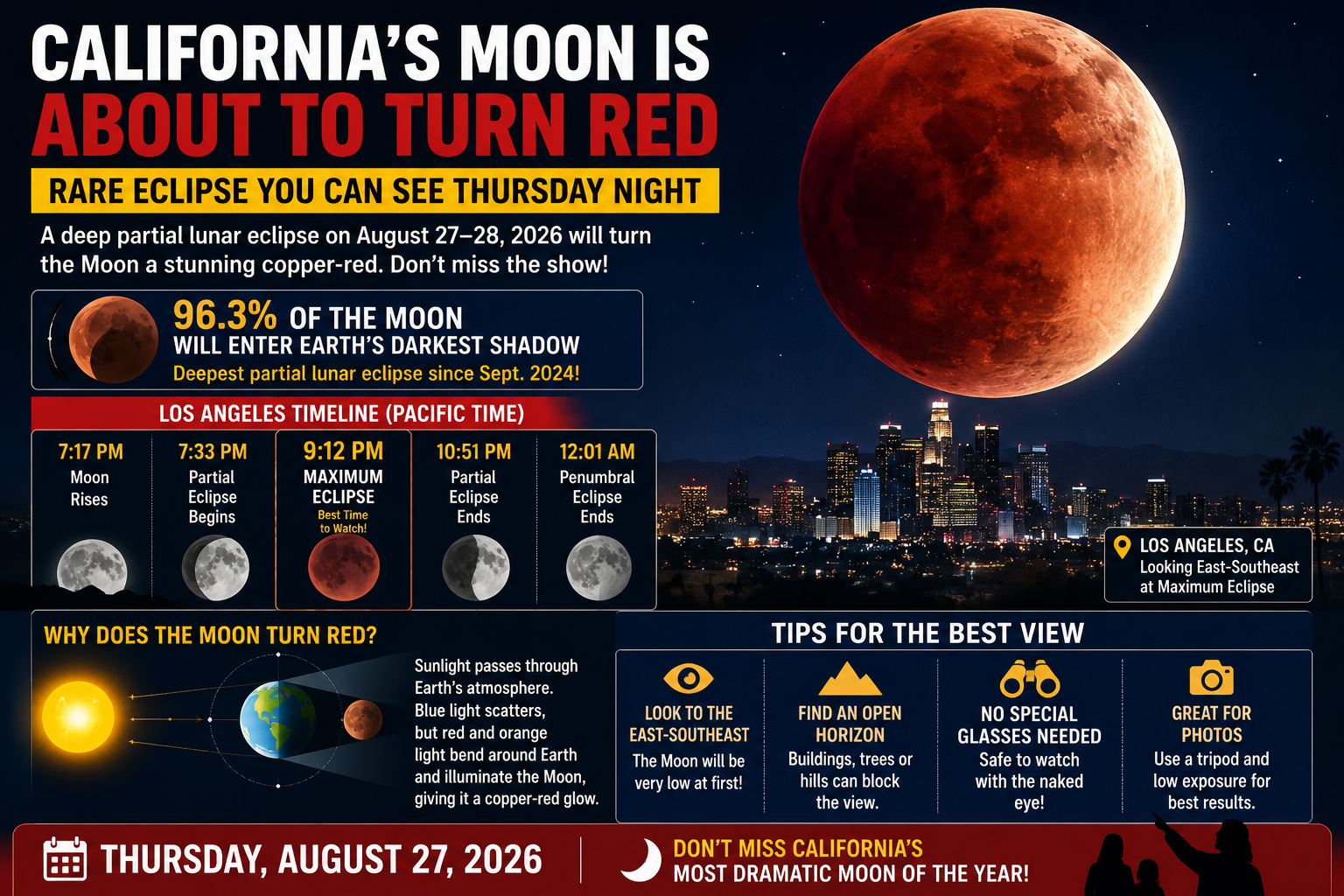
At maximum eclipse, 96.3% of the Moon’s disk will be inside Earth’s darkest shadow, known as the umbra. That makes this the deepest partial lunar eclipse since September 2024 and the most visually dramatic one expected until late 2028.
And California is in an excellent position to see it.
For Los Angeles, the most important moment comes at approximately 9:12 p.m. Pacific Time Thursday.


5
The Moon Will Almost Completely Disappear Into Earth’s Shadow
During a lunar eclipse, Earth moves between the Sun and the Moon.
Normally, sunlight illuminates the full Moon.
During the eclipse, Earth blocks direct sunlight from reaching the lunar surface.
But the Moon doesn’t simply go completely black.
Some sunlight passes through Earth’s atmosphere, where it is scattered and refracted before reaching the Moon.
The remaining light is dominated by red and orange wavelengths.
That’s why the eclipsed portion can take on a copper, orange or reddish appearance.
NASA says the August event will see the Moon pass through both Earth’s penumbra and umbra, with 96.3% of its disk inside the umbra at greatest eclipse.
So Is It a Blood Moon?
You will probably see plenty of people calling it a “Blood Moon.”
That’s understandable because most of the Moon will appear reddish.
But technically, astronomers classify this as a partial lunar eclipse, because a small portion of the Moon will remain outside the umbra.
That small bright section will prevent the entire Moon from reaching totality.
The result could actually be more dramatic: a dark copper-red Moon with a thin, bright crescent-like section remaining illuminated.
When Can Californians See It?
For Los Angeles, the timing is particularly convenient because the most dramatic portion occurs during the evening rather than in the middle of the night.
Los Angeles eclipse timeline
| Event | Time — Pacific |
|---|---|
| Moon rises | 7:17 p.m. |
| Partial eclipse begins | 7:33 p.m. |
| Maximum eclipse | 9:12 p.m. |
| Partial eclipse ends | 10:51 p.m. |
| Penumbral eclipse ends | 12:01 a.m. |
The Moon will continue rising higher in the sky as the eclipse progresses.
That makes around 9:12 p.m. the time to remember.
If you only have time to step outside once, that’s the moment to aim for.


4
The First 20 Minutes Could Be Difficult to See
There is one important catch for Southern California.
The Moon will be extremely low on the horizon when the partial eclipse begins.
In Los Angeles, the Moon rises at 7:17 p.m., while the partial eclipse begins at 7:33 p.m.
At that point, the Moon is only about 2.6 degrees above the east-southeastern horizon.
That means:
- Buildings could block it.
- Trees could block it.
- Hills could block it.
- Mountains could block it.
- Even a nearby roof could get in the way.
So don’t pick your viewing location based solely on how attractive it looks during daylight.
You need an open view toward the east-southeast.
By 9:12 p.m., the Moon will be about 21 degrees above the horizon in Los Angeles, making the eclipse much easier to observe.
Where Should You Watch From in California?
You don’t need to drive to a remote desert or mountain.
In fact, the most important thing isn’t necessarily darkness.
It’s a clear horizon.
A location with a wide view toward the east-southeast can be better than a very dark location surrounded by buildings or trees.
Potential viewing spots include:
- Open beaches
- Large parks
- Desert areas
- Open fields
- Elevated viewpoints
- Rooftops where public access is permitted
- Areas outside dense urban neighborhoods
For the first part of the eclipse, an unobstructed horizon could make the difference between seeing the Moon and seeing nothing at all.


6
Southern California Could Have a Beautiful Backdrop
Los Angeles and San Diego residents have an advantage when it comes to potential photography.
A low Moon rising over:
- The Pacific horizon
- Downtown Los Angeles
- Palm trees
- Mountain silhouettes
- Coastal cliffs
could create a much more dramatic photograph than a Moon photographed against a completely black sky.
The trick is to plan the composition before the eclipse begins.
If you’re photographing the event, arrive early enough to find the Moon’s expected rising direction.
What About San Francisco and Northern California?
The eclipse is also visible from Northern California.
But local viewing conditions will matter.
In Sunnyvale, for example, the partial phase begins around 7:33 p.m., with maximum eclipse at 9:12 p.m. The Moon is extremely low around the beginning of the eclipse and rises to about 17 degrees above the horizon at maximum.
That means Bay Area viewers face a similar challenge:
Find an unobstructed view toward the east-southeast.
Cloud cover could also make a major difference.
So Californians should check their local forecast on Thursday afternoon rather than assuming conditions will be identical across the state.
You Don’t Need Eclipse Glasses
This is one of the easiest astronomical events to watch.
Unlike a solar eclipse, a lunar eclipse is safe to view with your naked eyes.
There is no need for special eclipse glasses.
You can simply go outside and look at the Moon.
Binoculars can make the changing shadow easier to see, while a telescope can reveal much more detail.
But neither is required.
For most people, the best equipment may simply be:
A comfortable chair and a clear view of the sky.
Want to Photograph the Red Moon? Here’s What Actually Helps
The eclipse should also be a great opportunity for amateur photographers.
The biggest mistake people make when photographing the Moon is assuming a phone will automatically produce a large, detailed lunar image.
It usually won’t.
The Moon is surprisingly small in a normal smartphone frame.
Instead:
Use a tripod
Even tiny movements can blur a night-sky photograph.
Use the longest optical zoom available
If your phone has a dedicated telephoto lens, use it rather than simply zooming digitally.
Lower the exposure
The Moon is much brighter than the surrounding sky.
Automatic exposure can make the lunar surface appear like a glowing white circle.
Take multiple shots
The eclipse changes constantly.
Take photographs throughout the event and compare them afterward.


5
The Best Photo May Not Be a Close-Up
If you have a powerful camera, a close-up of the eclipsed Moon can be impressive.
But for a smartphone user, a landscape photograph may actually look better.
Try placing the Moon above:
- Los Angeles skyline
- A California mountain
- Palm trees
- A beach
- A recognizable building
The red Moon against a California landscape can tell a much stronger visual story than a tiny Moon floating in a black sky.
Why Will the Moon Look Red?
The explanation is surprisingly beautiful.
Think of Earth’s atmosphere as a giant filter.
When sunlight passes through the atmosphere, blue light is scattered more easily.
Red and orange light travel farther through the atmosphere.
During the eclipse, some of that filtered light bends around Earth and reaches the Moon.
The Moon therefore receives a faint reddish glow instead of becoming completely dark.
The same basic scattering effect helps produce red and orange sunsets.
During a lunar eclipse, however, that atmospheric light is projected onto the Moon.
That’s what creates the famous copper-red eclipse appearance.
How Much of the Moon Will Actually Turn Red?
Almost all of it.
At maximum eclipse, 96.3% of the Moon’s disk will be inside Earth’s umbra.
That is why this event is expected to look much closer to a total lunar eclipse than an ordinary partial eclipse.
A small section will remain outside the umbra.
That portion will continue receiving direct sunlight.
The result should be a striking contrast between the bright section and the dark copper-red portion.
This Is the Deepest Partial Lunar Eclipse Until 2028
This isn’t just another ordinary lunar eclipse.
According to Space.com, the August 27–28 eclipse is the deepest partial lunar eclipse since September 2024 and is expected to be the most visually impressive partial eclipse until December 2028.
NASA’s calculations put the maximum at 96.3% umbral coverage.
So even people who normally don’t follow astronomy may find this one worth watching.
And There’s Another Reason to Look Up
The August eclipse coincides with the full Sturgeon Moon.
That means Californians aren’t watching an ordinary Moon move into Earth’s shadow.
They’re watching the full Moon undergo a dramatic transformation during one of the year’s most notable celestial events.
And because the event occurs relatively early in the evening on the West Coast, families don’t have to stay awake until the middle of the night to see the most interesting part.
A Simple Plan for Thursday Night
If you want to watch the eclipse without making it complicated, here’s the easiest plan:
7:00 p.m.
Get outside and find a clear east-southeast horizon.
7:15–7:30 p.m.
The Moon rises in Southern California.
7:33 p.m.
The partial eclipse begins in Los Angeles.
8:00–9:00 p.m.
The shadow becomes increasingly obvious.
9:12 p.m.
Maximum eclipse.
This is the moment most people should try to be outside.
10:51 p.m.
The partial eclipse ends.
Midnight
The subtle penumbral phase ends.
The entire event lasts several hours, but you don’t have to watch every minute.
What If It’s Cloudy?
This is the one thing nobody can control.
A lunar eclipse doesn’t care whether you have the perfect camera, the perfect telescope or the perfect viewing location.
If clouds cover the Moon, you won’t see it.
That’s why checking the local forecast on Thursday afternoon is important.
And if your neighborhood is cloudy, don’t immediately assume the entire region is.
Conditions can vary considerably over relatively short distances.
Don’t Confuse This With a Solar Eclipse
There is an important safety distinction.
A solar eclipse requires eye protection because looking directly at the Sun can damage your eyes.
A lunar eclipse is completely different.
The Moon is reflecting sunlight rather than producing it, and watching a lunar eclipse directly is safe.
So if someone tells you that you need special eclipse glasses for Thursday night:
That’s not necessary for a lunar eclipse.
The Best Viewing Tip May Be the Simplest
Don’t wait until 9:12 p.m. to start looking for the Moon.
Because the Moon rises so close to the beginning of the partial phase, you should ideally choose your location beforehand.
Find somewhere with:
A clear east-southeast view.
That’s more important than finding an expensive telescope or a remote location.
Once the Moon climbs higher, the viewing becomes much easier.
The Bottom Line
California is about to get one of the year’s most impressive nighttime sky events.
On Thursday, August 27, the Moon will move deeply into Earth’s shadow, with 96.3% of its disk entering the umbra at maximum eclipse.
In Los Angeles, the partial eclipse begins at approximately 7:33 p.m., reaches its maximum at 9:12 p.m., and ends at 10:51 p.m. Pacific Time.
The Moon will appear increasingly dark and copper-red as Earth’s shadow covers it.
And because the Moon will be extremely low when the eclipse begins, location matters.
If you’re in California, find an open view toward the east-southeast, get outside before maximum eclipse, and be ready around 9:12 p.m.
You don’t need special glasses.
You don’t need an expensive telescope.
You don’t even need a professional camera.
You just need a clear sky — and a reason to look up.
🌙 Quick California Viewing Guide
Event: Deep Partial Lunar Eclipse
Date: Thursday, August 27, 2026
Peak: Approximately 9:12 p.m. PT in California
Maximum coverage: 96.3% of the Moon’s disk
Best direction: East-southeast early in the evening
Eye protection: Not required
Best equipment: Binoculars/camera optional
Best viewing strategy: Find an unobstructed horizon
Official & Useful Links
NASA — August 27–28, 2026 Deep Partial Lunar Eclipse
Los Angeles Eclipse Timing & Visibility
Sunnyvale / Bay Area Eclipse Timing
Space.com — Complete August 2026 Eclipse Guide
AI Image Disclosure
Image Disclaimer: Images used in this article may include AI-generated illustrations created for CalNews360 to visually explain the astronomical event. They are for editorial and illustrative purposes and should not be interpreted as actual photographs of the August 27, 2026 eclipse or as guarantees of local weather and viewing conditions.