






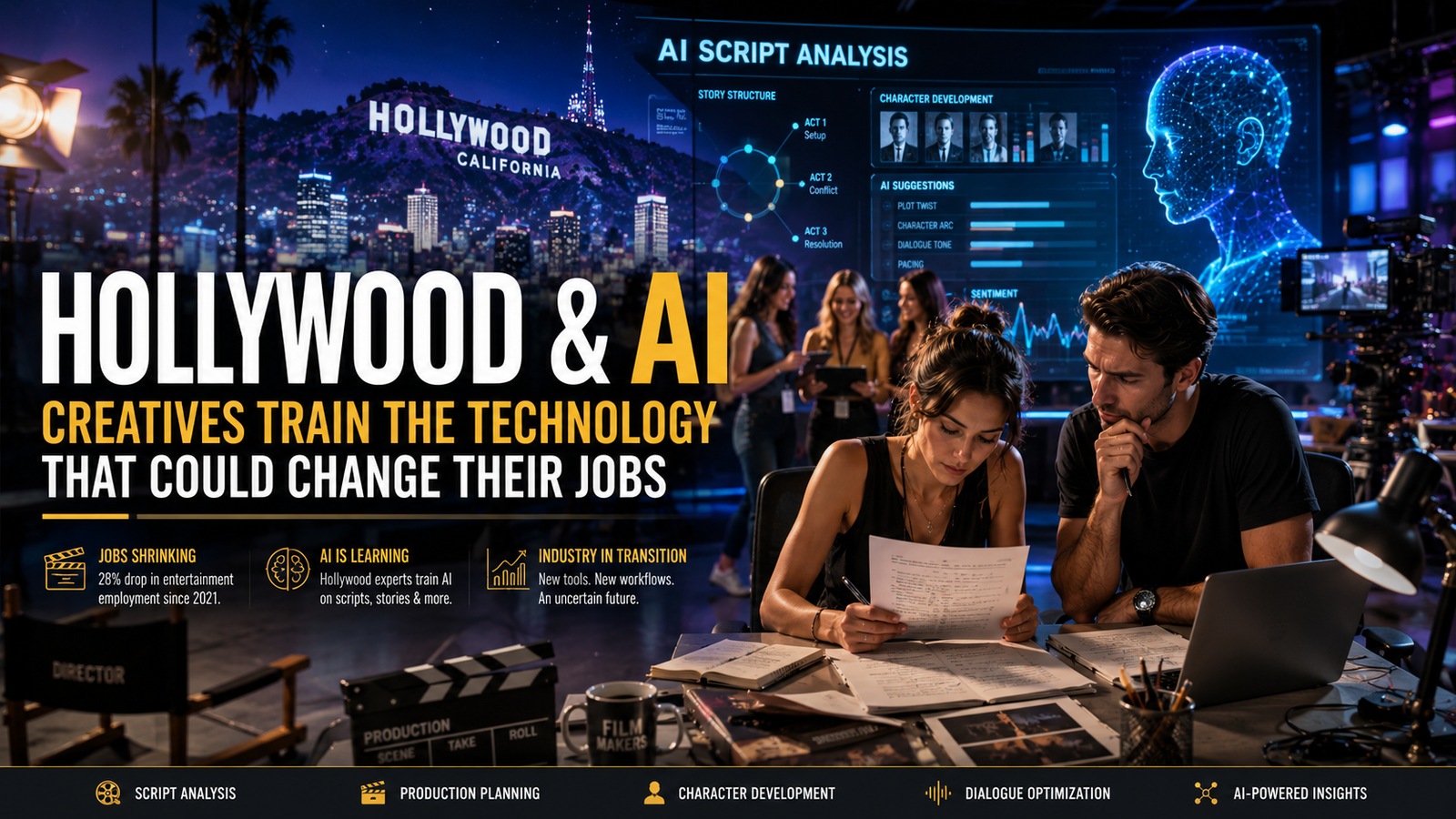
LOS ANGELES — Hollywood’s artificial-intelligence debate has entered an uncomfortable new phase: some of the industry’s experienced writers, directors and producers are now being paid to teach AI systems how to perform the very creative and production tasks they once did themselves.
A report published Saturday, August 22, found that award-winning Hollywood professionals are taking temporary AI-training assignments as traditional entertainment work becomes harder to find. Some are earning between $12 and $200 an hour to evaluate and improve AI systems on tasks including screenwriting, production planning and pitch development.
The development offers a striking look at how quickly AI is moving from a technology Hollywood debates to a source of income — and potential competition — for the people who actually make movies and television.
Why Hollywood Creatives Are Training AI
The reason is increasingly practical: there are fewer traditional jobs available.
The Hollywood employment market has been under pressure for several years following the pandemic-era production slowdown, the 2023 strikes, changes in streaming economics and the industry’s broader shift toward producing fewer projects.
According to the report, Los Angeles experienced a 48% decline in shoot days between 2021 and 2025, while employment in the U.S. motion picture and sound-recording industries fell by 28% over the same period.
For experienced professionals who may have spent decades working in film and television, AI-training assignments can therefore provide an unexpected source of income while traditional production opportunities remain limited.
What Are They Actually Teaching AI?
The work goes beyond simply asking an AI chatbot to write a movie.
Hollywood professionals are being asked to evaluate AI systems and teach them specialized knowledge gained through years of industry experience.
That can include:
- Screenwriting and story development
- Character and narrative evaluation
- Film-production planning
- Shooting schedules
- Pitch-deck development
- Production logistics
- Creative decision-making
- Industry-specific workflows
One example cited in the reporting involved a Los Angeles screenwriter and producer who trained an AI system to create a detailed film shooting schedule, incorporating issues such as permits, locations, daylight conditions and personnel requirements.
In other words, the professionals aren’t simply teaching AI what Hollywood looks like. They are helping it understand how Hollywood actually works.
The Hollywood AI Paradox
That creates an obvious contradiction.
A writer or producer who cannot find enough traditional work can earn money by helping an AI system become better at performing tasks that might eventually require fewer human workers.
Some of the professionals involved have expressed discomfort about that possibility, while others view the work as a practical response to an industry that is already changing.
The dilemma is particularly significant in Hollywood because many creative careers traditionally depend on people learning through entry-level and mid-level positions before moving into more senior roles.
If AI reduces the number of those jobs, the industry could eventually face a different problem: where will the next generation of writers, editors, producers and other creative professionals get their experience?
OpenAI and Anthropic Are Part of the Bigger Picture
The AI-training work is being facilitated by specialized companies and training agencies that recruit experts from fields including entertainment, finance, health, law and social work.
The Guardian reported that some of these agencies have contracts connected to major AI companies including OpenAI and Anthropic.
That means Hollywood’s AI transition is not happening in isolation.
AI companies need people with real-world expertise to evaluate whether their models can perform professional tasks accurately. Hollywood professionals, meanwhile, have knowledge that AI systems cannot simply acquire from a job title or a basic internet search.
The result is a new type of labor market in which experienced professionals are temporarily becoming teachers, evaluators and quality-control experts for AI systems.
Is AI Already Taking Hollywood Jobs?
The latest development should not be interpreted as proof that AI has already replaced Hollywood’s workforce on a massive scale.
The industry is facing several overlapping pressures, and AI is only one of them.
Streaming economics, reduced production volumes, changing audience behavior, higher production costs and the aftermath of Hollywood’s labor disruptions have all contributed to the employment downturn.
But AI is becoming increasingly important because it can automate or accelerate certain tasks that previously required human workers.
The technology is already being explored across areas such as visual effects, editing, pre-production, marketing and development.
That makes the current trend significant even if AI is not yet capable of replacing an entire Hollywood production team.
Why This Matters for Los Angeles
For Los Angeles, the issue goes beyond individual creative careers.
Entertainment is a major part of the regional economy, supporting not only actors, writers and directors but also:
- Camera crews
- Editors
- Production assistants
- Costume workers
- Set designers
- Transportation companies
- Catering businesses
- Equipment suppliers
- Post-production companies
- Sound professionals
- Independent production companies
A sustained reduction in production activity can therefore affect businesses far beyond the studio lot.
The reported 48% decline in L.A. shoot days between 2021 and 2025 is particularly important because filming activity generates work across a large network of companies and workers.
Could AI Eventually Create Hollywood Jobs Too?
Not everyone sees AI exclusively as a threat.
Some entertainment professionals believe the technology could make it possible to produce projects that might otherwise never receive funding.
Lower production costs could allow independent filmmakers and smaller studios to experiment with ideas that would previously have been too expensive.
AI could also create entirely new positions involving:
- AI-assisted filmmaking
- AI production supervision
- Synthetic media compliance
- AI creative direction
- Model evaluation
- Digital asset management
- AI-assisted visual effects
The question is whether those new jobs will replace enough of the traditional positions being lost — and whether they will provide comparable career paths.
The Bigger Question: Who Owns the Future of Hollywood?
Hollywood has spent years debating whether AI should be used to recreate actors, generate visual effects, write material or assist filmmakers.
The latest development introduces another dimension to that debate.
What happens when the people most capable of teaching AI Hollywood’s creative processes are also the people whose jobs are most vulnerable to automation?
For some workers, training AI may be a way to stay connected to the industry and earn money during a difficult period.
For others, it may feel like helping build a system that could eventually make their profession smaller.
That tension is likely to remain at the center of Hollywood’s AI debate as studios, technology companies, unions and creative professionals negotiate what the next generation of entertainment work will look like.
What Hollywood Workers Should Watch Next
The most important developments over the coming years may not be whether AI can produce an entire movie.
Instead, watch how many individual tasks are gradually moved into AI-assisted workflows.
If AI begins handling more development, scheduling, editing, visual effects, marketing and other production functions, the industry’s staffing model could change even without completely replacing human filmmakers.
For Los Angeles, that could mean a Hollywood that still produces movies and television — but with fewer people performing more specialized roles alongside increasingly capable AI systems.
The people currently training those systems may ultimately become some of the most important voices in determining how that transition happens.
The Bottom Line
Hollywood’s AI transformation is no longer just a debate about futuristic technology.
Experienced writers, directors and producers are already being paid to train AI systems on the skills they spent years developing. With traditional entertainment employment under pressure, the work can provide income today — even as it raises difficult questions about the jobs that may exist tomorrow.
For Los Angeles, the issue is bigger than Hollywood’s studios. It could affect the broader entertainment workforce and the career pipeline that has supported the city’s creative economy for generations.
The irony is hard to miss: some of the people teaching AI how to work in Hollywood may also be teaching it how to require fewer people to work in Hollywood.
Official / Source Links
Source: The Guardian — Hollywood creatives training AI to do their jobs
AI information: OpenAI
AI information: Anthropic
AI Image Disclosure
Image Disclaimer: The featured image in this article was generated using artificial intelligence (AI) for illustrative and editorial purposes. It does not depict an actual Hollywood production, person, event or workplace.