









By CalNews360 Staff
Published: August 22, 2026
Hollywood’s fight over the proposed Paramount Skydance–Warner Bros. Discovery merger has taken a new turn, and California is now at the center of the dispute.
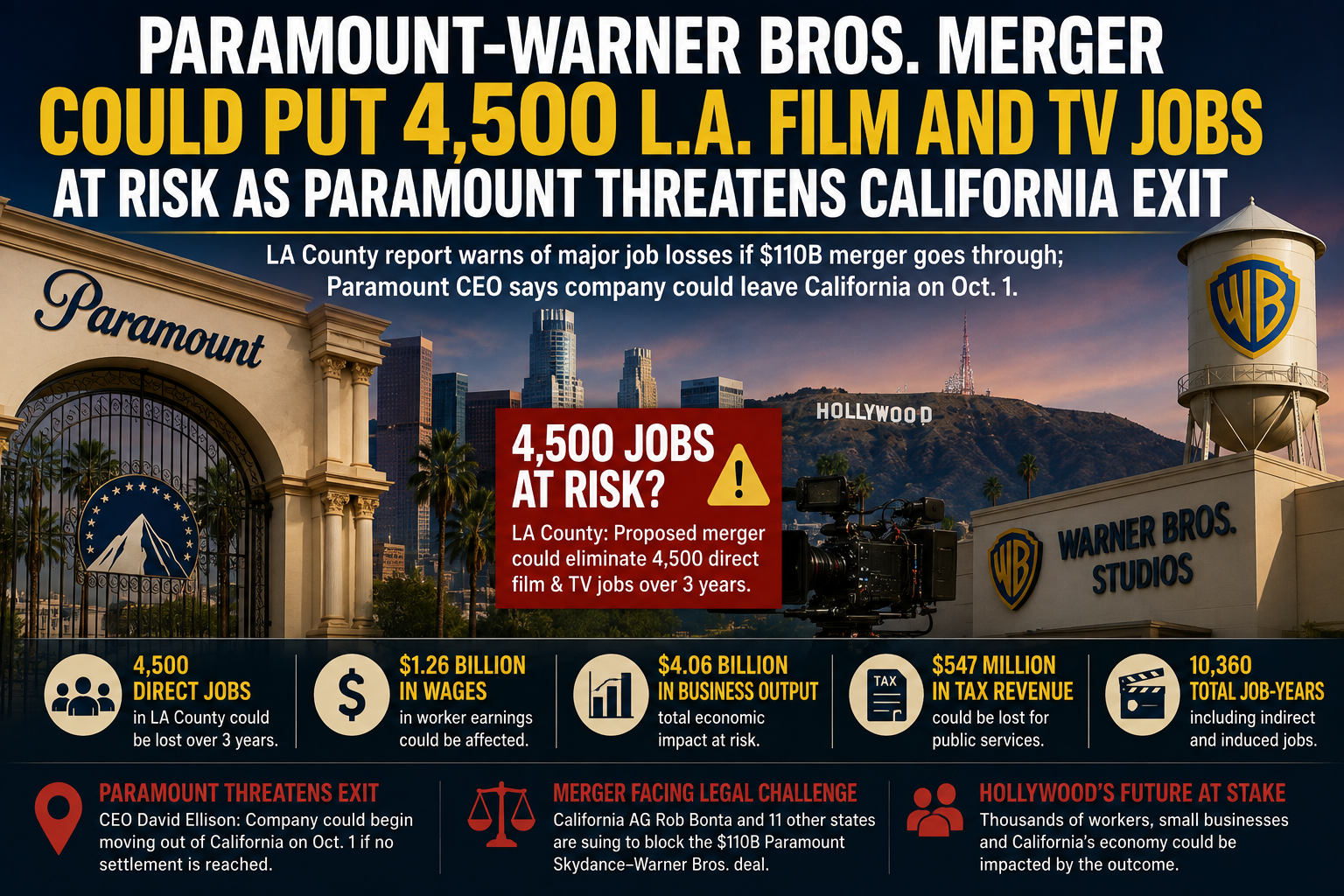
Paramount CEO David Ellison has threatened to begin moving the company out of California as soon as October 1 if California Attorney General Rob Bonta does not negotiate a settlement over the state’s lawsuit seeking to block the $110 billion-plus Warner Bros. Discovery acquisition.
At the same time, a new Los Angeles County analysis warns that if the merger goes ahead, approximately 4,500 direct film and television jobs in Los Angeles County could be lost over three years, with more than 10,000 total job-years potentially exposed.
The dispute has now become much bigger than a corporate merger.
It raises a question that matters to California:
Could one of Hollywood’s biggest mergers accelerate the loss of film and television jobs from Los Angeles — and could Paramount actually leave the state?
What Is Happening With Paramount and Warner Bros.?
Paramount Skydance is pursuing a proposed acquisition of Warner Bros. Discovery valued at roughly $110 billion.
The transaction would bring together two of Hollywood’s major entertainment companies and their extensive film, television and media businesses.
But California Attorney General Rob Bonta and attorneys general from 11 other states are fighting the deal in federal court.
California’s lawsuit argues that combining Paramount and Warner Bros. Discovery would reduce competition in film distribution and television, potentially leading to higher prices, fewer choices and less competition for workers and businesses.
The lawsuit was filed in July under Section 7 of the Clayton Act, which prohibits mergers that may substantially lessen competition or tend to create a monopoly.
The proposed transaction therefore remains unresolved.
It has not closed.
Why Is Paramount Threatening to Leave California?
Paramount’s threat is tied directly to the legal fight over the merger.
According to recent reporting, Ellison has told Paramount executives that the company could begin moving its operations out of California on October 1 if Bonta does not negotiate a settlement with Paramount and the other states challenging the deal.
The October 1 date is significant because Paramount says a $7 million-per-day “ticking fee” connected to the transaction begins at that point while the merger remains unresolved.
Paramount has reportedly considered relocating operations to another state rather than continuing to absorb the costs and uncertainty associated with the stalled transaction.
But Californians should be careful about one important distinction:
Paramount has threatened a potential move. It has not left California.
Gov. Gavin Newsom said Friday that he does not believe Paramount leaving is likely, although he is taking the possibility seriously. Newsom also said he wants the parties to pursue the “best deal” through settlement discussions if possible.
How Many California Jobs Could Be at Risk?
The most significant new warning comes from Los Angeles County.
On August 19, the county released a final 120-day analysis prepared by CVL Economics for the Los Angeles County Department of Economic Opportunity and LA County Film Office.
The report estimates that approximately:
- 4,500 direct film and TV jobs could be lost in Los Angeles County over three years
- 10,360 total job-years could be exposed
- 2,661 indirect jobs at production-support businesses could be affected
- 3,204 induced jobs connected to local spending could also be at risk
- $1.26 billion in wages could be affected
- $2.78 billion in economic value could be at risk
- $4.06 billion in total business output could be affected
- $547 million in tax revenue could be at risk
The county emphasizes that these numbers are not a prediction that 4,500 people will definitely be laid off.
Instead, they are an estimate of the potential employment exposure if the merger closes and the companies consolidate operations in the ways modeled by the report.
That distinction is important.
It’s Not Just Actors and Directors
One of the biggest misconceptions about Hollywood job losses is that the impact is limited to actors, writers and directors.
The county’s analysis shows how much larger the entertainment economy is.
Potentially affected workers and businesses include:
- Production crews
- Camera and lighting workers
- Editors
- Set and construction workers
- Prop houses
- Transportation companies
- Printers
- Post-production businesses
- Production vendors
- Restaurants
- Retail businesses
- Other local service providers
The county estimates that 2,661 indirect jobs at small businesses supporting film and television production could be exposed.
Another 3,204 jobs could be affected because entertainment workers spend money throughout the local economy.
That means a reduction in Hollywood production can extend far beyond the studio lot.
Why Could the Merger Eliminate Jobs?
The biggest issue is consolidation.
Paramount and Warner Bros. Discovery currently operate separately, meaning they have separate corporate teams, production operations, content pipelines and other overlapping functions.
If they combine, some of those operations would likely overlap.
The Los Angeles County report identifies several mechanisms through which that consolidation could affect local employment.
One is slate consolidation — essentially, fewer buyers potentially approving fewer projects.
Another involves overlapping production workforces and creators who have exclusive agreements with one or both companies.
The report says approximately 895 creators hold exclusive deals with the two companies, creating additional exposure if development and production activity declines.
Hollywood Is Already Losing Production
The merger is arriving at a difficult time for California’s entertainment industry.
Los Angeles County says its creative economy supports more than 312,000 workers, including approximately 171,155 entertainment-sector jobs.
But production has already been moving away from Los Angeles.
According to the county report, California has lost 52,016 film and television jobs since 2022, with 99.6% of those losses occurring in Los Angeles County.
FilmLA data cited by the county also shows that on-location production activity in Los Angeles County fell 16% in 2025 compared with 2024.
That makes the Paramount-Warner Bros. fight particularly important.
The concern isn’t simply what happens to two companies.
It’s whether another major restructuring could accelerate an existing trend of production leaving California.
Why Is Production Leaving California?
The county’s analysis points to several factors.
Among them are:
- California’s high cost of living
- Production incentives offered by other states and countries
- California’s tax-credit environment
- Decisions by studios about where to film
- The broader decline in traditional television revenue
- Changes in the streaming business
The report found that of 73 films on the combined Paramount-Warner Bros. 2025 slate with an identified filming location, only four were filmed in California and just one in Los Angeles County.
That does not mean Paramount and Warner Bros. are abandoning California.
But it illustrates how much production already takes place elsewhere.
Could Paramount Really Leave California?
That remains uncertain.
Paramount has publicly threatened to begin moving operations out of the state if negotiations over the merger do not progress.
But moving a major entertainment company is not something that happens overnight.
Paramount has a deep history and infrastructure in Hollywood, including its famous studio lot and a large workforce in Southern California.
TheWrap reported that Ellison has said his goal is to keep Paramount’s 30,000 jobs in Southern California, while simultaneously warning executives that the company could move if the legal dispute isn’t resolved.
That creates an unusual situation:
Paramount is threatening a California exit while saying it wants to preserve its Southern California workforce.
Exactly how much of the company’s operations would move, and how quickly, remains unclear.
What Does California Attorney General Rob Bonta Say?
Bonta’s position is that the merger should not be allowed to proceed without significant protections for competition.
California’s lawsuit argues that Paramount and Warner Bros. are two of the five major U.S. film distributors.
According to the Attorney General’s office, the combined company would have approximately 27% of the wide-release theatrical film distribution market.
The state also argues that the merger could affect movie theaters, television distributors, workers and consumers.
Bonta has rejected the idea that California should simply allow the transaction to proceed because of the threat of Paramount leaving.
The state and its coalition partners are seeking to block the merger unless their competition concerns are addressed.
Gov. Newsom Wants a Deal
The political situation became even more interesting Friday.
Gov. Gavin Newsom said he wants Bonta and Paramount to find a settlement if they can reach what he described as the best deal for California.
Newsom said discussions are taking place and acknowledged that the future of Hollywood in California is at stake.
The governor also said he is concerned about California’s reputation and wants Hollywood to remain in the state.
But Bonta is part of a coalition of 12 state attorneys general, meaning California cannot simply make a decision in isolation from the other states involved in the lawsuit.
When Could the Merger Be Decided?
The merger is not expected to be resolved immediately.
The Los Angeles County report says a court stipulation entered July 24 prevents the transaction from closing until the earlier of five days after a decision on the merits or June 1, 2027.
The trial is scheduled for March 2–19, 2027.
That means the legal fight could continue for months.
At the same time, Paramount’s October 1 deadline creates pressure for the parties to reach an agreement sooner.
What Could Happen to Los Angeles If Paramount Leaves?
The consequences would depend heavily on what “leaving California” actually means.
A complete departure of major operations would potentially affect:
- Studio employment
- Local production spending
- Property activity
- Production vendors
- Restaurants and local businesses
- Film and television crews
- California tax revenue
- Los Angeles’ ability to attract future productions
But a partial relocation would have a different effect.
The company could potentially move certain corporate or operational functions while keeping substantial production activity in Southern California.
At this point, there is not enough evidence to say exactly what a Paramount departure would look like.
Could This Affect Moviegoers?
Potentially.
California’s lawsuit argues that combining two major film distributors could reduce competition and ultimately affect movie theaters and audiences.
The Attorney General’s office says the two companies currently compete with theaters for screens, release dates and financial terms.
Paramount’s supporters, meanwhile, argue that the combined company could produce efficiencies and help strengthen the businesses.
The ultimate effect on movie prices, movie availability and streaming costs remains uncertain.
What Happens Next?
Several developments could occur over the coming weeks.
First, negotiations between Paramount and the states could continue.
Second, Paramount’s October 1 ticking-fee deadline is approaching.
Third, the federal antitrust litigation will continue toward the scheduled March 2027 trial unless the parties reach a settlement or the court timetable changes.
Fourth, Los Angeles and California officials will continue trying to protect production jobs and keep Hollywood activity in the state.
The county has already begun developing a workforce response that includes job fairs, assistance through 18 America’s Job Centers of California, unemployment-insurance assistance and connections between potentially displaced workers and employers receiving California production tax credits.
What This Means for Californians
For most Californians, the immediate impact will not be whether Paramount’s headquarters physically moves.
The bigger issue is the health of California’s entertainment economy.
Hollywood supports far more jobs than those carrying an actor’s name in the credits.
When production falls, the effects can reach truck drivers, caterers, editors, construction workers, restaurants, hotels, equipment suppliers and many other businesses.
That is why the 4,500-job estimate matters even to people who have never worked in a movie studio.
It is also why the governor, attorney general and Los Angeles County are all paying close attention to what happens next.
The Bottom Line
Paramount has not left California, and the Warner Bros. Discovery merger has not been completed.
But the situation is becoming increasingly serious.
Paramount CEO David Ellison has threatened to begin moving the company out of California on October 1 if the states challenging the merger do not negotiate a settlement.
Meanwhile, a new Los Angeles County analysis estimates that the proposed merger could put approximately 4,500 direct film and television jobs at risk, along with more than 10,000 total job-years and billions of dollars in wages, economic activity and tax revenue.
Gov. Gavin Newsom now says he wants the parties to find a settlement that protects California’s interests, while Attorney General Rob Bonta continues to challenge the merger in court.
For Hollywood workers and the thousands of businesses that depend on entertainment production, the next several weeks could be critical.
Sources: Los Angeles County Department of Economic Opportunity; LA County Film Office; California Attorney General’s Office; TheWrap; Variety; Reuters.
Image note: The image used with this article is AI-generated for illustrative purposes only and does not represent an actual Paramount or Warner Bros. merger event, corporate decision, employee layoff or future relocation.